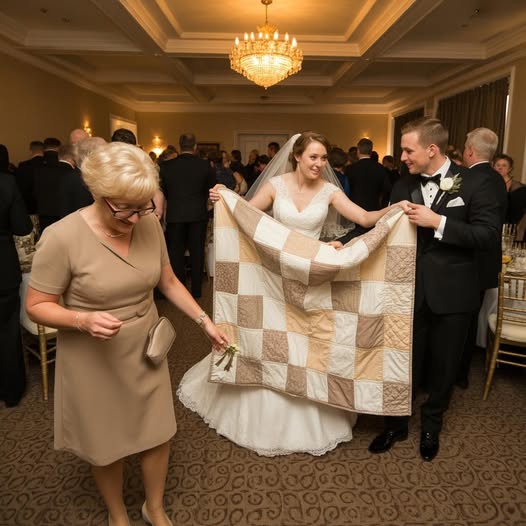
The room had turned itself into a spectacle long before anyone realized what was being sacrificed inside it. Laughter didn’t just fill the air—it sliced through it, sharp and contagious, bouncing off crystal chandeliers and polished walls like it belonged there. Four hundred strangers leaned forward in their seats, delighted by what they thought was harmless humor, unaware that they were watching something far more fragile than entertainment unfold.
At the center of it all stood a frail old woman, her hands trembling slightly as she held up a handmade quilt. It wasn’t just fabric and thread. It was three weeks of aching fingers, late nights under dim light, and sixty years of memories carefully stitched into every square. Each pattern carried a story—some joyful, some painful, all deeply personal. But in that moment, it was reduced to a prop, dangling under bright lights as the crowd laughed louder, mistaking tenderness for comedy.
And then her grandson stepped forward.
He didn’t rush. He didn’t shout over the noise or try to wrestle attention back from the room. He simply took the microphone, and for a brief moment, the laughter faltered—not because he demanded silence, but because something in his presence made people hesitate.
When he spoke, his voice was steady, almost soft. Five sentences. That was all it took.
He didn’t accuse anyone. He didn’t insult the crowd. He didn’t beg for understanding. He only named what they had mocked. His grandfather’s worn shirt. His childhood blanket. His grandmother’s wedding veil. Every piece of fabric they had laughed at was not decoration, not nostalgia, but history—each stitch a quiet act of devotion that had held his life together far longer than any applause ever could.
As he spoke, something shifted inside him. Beneath the glare of stage lights and the distant echo of laughter dying too slowly, he realized the uncomfortable truth: the life he had been chasing—approval, attention, the glittering approval of strangers—no longer resembled the person he was becoming, nor honored the people who had built him with their hands, their time, and their love.
The room didn’t know how to respond. Applause felt suddenly heavy. Silence felt too honest.
When it was all over—the lights dimmed, the orchestra stopped, and the crowd dissolved into polite indifference—he didn’t stay to be congratulated. He left the polished floors and echoing halls behind and found her again in the place where none of it had ever mattered.
The kitchen was small, worn, and familiar. No chandeliers. No audience. Just chipped mugs resting on a faded table, the scent of almond pastries lingering in the air, and the quiet hum of a life that had never needed an audience to be real.
She was still there.
The quilt lay between them now, not as a spectacle but as something sacred again. He ran his fingers over the blue embroidery, each thread suddenly alive with meaning, like a map he had almost forgotten how to read. Neither of them spoke for a while. There was no need to.
He didn’t ask what came next. She didn’t pretend to have an answer.
Instead, they shared sugar and silence—simple, ordinary, and grounding—as if reclaiming something the world had tried to turn into a joke. And in that quiet kitchen, far away from the laughter that had once cut so deep, he understood something that no stage could ever teach him:
Love is not measured by applause, or by how loudly a room celebrates you, but by who you still choose to stand beside when the room turns cruel.