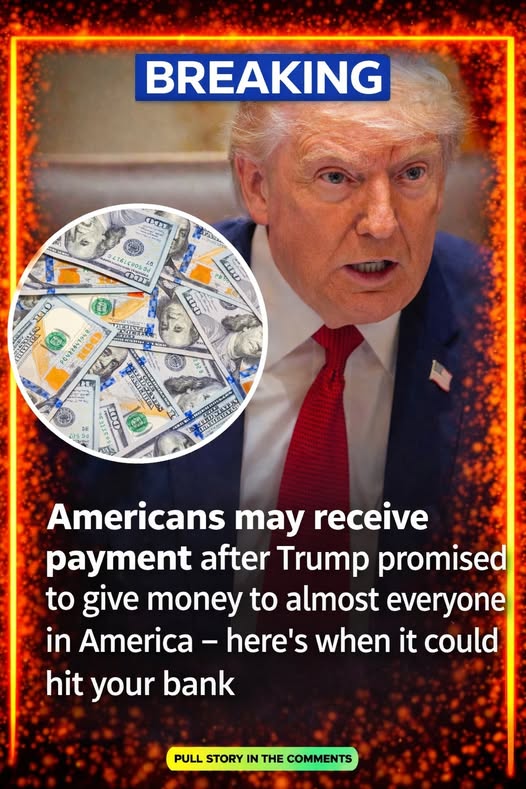
Americans were told that relief was on the way—real, tangible money meant to ease the pressure of rising costs. A figure began circulating everywhere: $1,745 in potential “refund” payments. For millions of families already stretched thin, it sounded like a lifeline finally within reach. But what began as a bold promise has now been pulled into confusion, political tension, and legal uncertainty, leaving the country staring at a plan that no longer feels certain.
At the center of the proposal was a striking idea: if tariffs drove up the cost of everyday goods, then the revenue generated from those tariffs should be returned directly to the people who felt the impact. Donald Trump promoted the concept as a tariff-funded “dividend,” targeted primarily at Americans earning under $100,000 a year. In his framing, it was meant to function as a form of economic compensation—money flowing back to households as a response to the rising cost of living many felt they had no control over.
But the plan quickly ran into a major roadblock. When officials attempted to structure the tariff revenue as direct payments to citizens, the Supreme Court of the United States intervened, halting the mechanism and ruling against the way the program was being implemented. That decision didn’t just delay the idea—it effectively dismantled the clear path needed to turn the proposal into real, deliverable checks, sending the entire initiative into legal and political limbo.
Behind the headline figure of $1,745 lies a more uncomfortable reality. Economists and analysts argue that this number reflects what many households have already absorbed in hidden costs—an estimated increase in spending between February 2025 and January 2026 driven by higher prices across everyday essentials. In that sense, the so-called “refund” is less a bonus and more an attempt to offset losses already felt in grocery bills, energy costs, and consumer goods.
Still, uncertainty dominates the conversation. Financial commentators and independent creators, including voices like Blind to Billionaire, are urging people not to rely on the payment as guaranteed income. While discussions about potential back-payments as late as mid-2026 continue to circulate, there is still no finalized legal pathway to make it happen. With the courts silent on a definitive resolution, expectations remain suspended in a fragile space between political hope and institutional hesitation.
For now, the $1,745 check exists less as a promise written in stone and more as a symbol of a larger national debate—over taxes, tariffs, fairness, and who ultimately bears the cost when economic policy collides with everyday life.