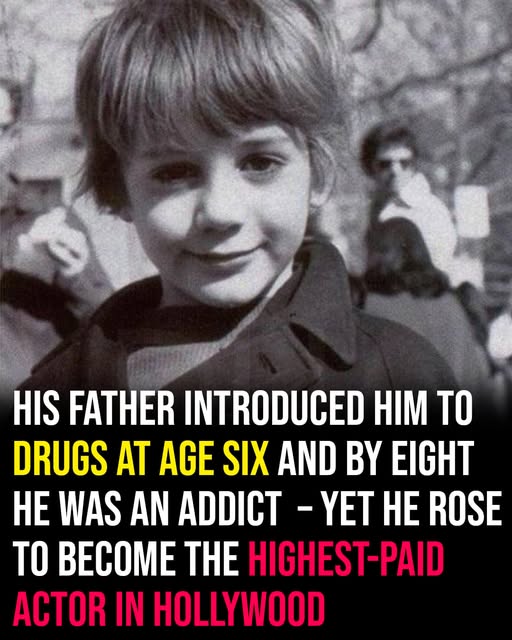
He was broken long before the world ever called him a legend. Long before the red carpets, the billion-dollar films, the roaring applause. Fame didn’t save him. Money didn’t save him. Even love—so close it almost wrapped him in something steady—couldn’t quite hold him above the surface. Because when addiction has its grip, it doesn’t loosen for applause or promises. It waits. And then it pulls.
Robert Downey Jr. was born into a world that looked dazzling from the outside but felt dangerously unsteady within. Hollywood wasn’t something he entered—it was something he inherited. Lights, cameras, scripts… they were part of the air he breathed. But so was chaos. So was confusion. And far too early, so were drugs. What should have been innocence was replaced with exposure, what should have been protection blurred into permission. A child didn’t just grow up—he adapted.
He didn’t have a childhood in the way most people understand it. He had scenes to play, expectations to meet, adults to mirror. Love came in unusual forms, sometimes wrapped in things that would later try to destroy him. When your foundation is cracked that early, it becomes hard to tell the difference between comfort and harm. Between affection and escape.
And yet, even inside that storm, his brilliance was undeniable.
On screen, he burned. There was something magnetic about him—sharp, unpredictable, alive. Audiences saw charisma. Directors saw genius. But behind the performances, behind the charm that seemed effortless, his real life was quietly unraveling. Success came fast, but stability never followed. The same intensity that made him extraordinary also made him fragile.
Then came the spiral.
It wasn’t one moment—it was many. Missed opportunities. Relationships collapsing under the weight of inconsistency and pain. Nights that blurred into mornings he couldn’t fully remember. Arrests that turned private struggles into public spectacle. Mugshots that replaced movie posters. And eventually, a prison cell—cold, final, and frighteningly close to becoming the end of his story.
For many, that would have been it.
Because addiction doesn’t just take—it erases. It rewrites futures. It convinces you that you’ve already gone too far to come back.
But somewhere in the wreckage, something in him refused to disappear.
The fight didn’t begin with a dramatic turning point. There was no single moment of clarity that fixed everything. Instead, it came quietly, painfully—one decision at a time. Sobriety wasn’t a miracle that arrived overnight. It was discipline. It was surrender. It was choosing, again and again, to face himself without escape.
He had to rebuild everything.
Trust didn’t return easily. Neither did opportunity. Hollywood, once so eager to embrace him, had grown cautious. And rightfully so. Redemption stories sound beautiful, but living one is slow, uncertain, and often lonely. He had to prove—not with words, but with consistency—that he could be someone new.
And slowly, impossibly, he did.
He became a partner who showed up. A father who stayed. A man who learned how to live without numbing the parts of himself that once felt unbearable. The same industry that had once watched him fall began, cautiously, to watch him rise.
Then came the role that would redefine everything.
When he stepped into the armor of Iron Man in the Iron Man, it wasn’t just casting—it was something deeper. A man who had nearly destroyed himself playing a man who builds something out of his own brokenness. It resonated. Not just because of the performance, but because of the truth behind it.
And the world saw it.
Film by film, he didn’t just return—he soared. Becoming the face of the Marvel Cinematic Universe, he helped shape one of the most successful franchises in cinematic history. But the real triumph wasn’t the box office numbers or the global fame. It was the fact that he was still there. Still standing. Still choosing differently.
His story doesn’t erase the damage. It doesn’t pretend the past didn’t happen. The scars remain, as they always do. But they no longer define the ending.
Because in the quietest, most powerful way, his life proves something many people need to hear:
Redemption is real. Not easy. Not clean. Not instant. But real.
And sometimes, the greatest role you’ll ever play…
is saving yourself.