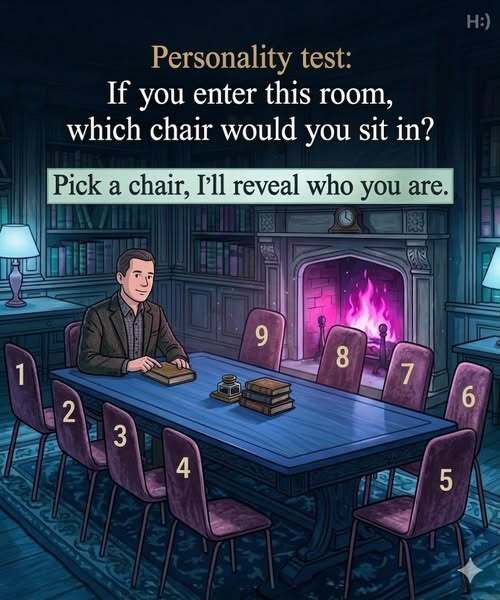
The chair you choose could change everything.
It rarely feels like a decision worth noticing—just a small, quiet movement of the body. A hand on the back of a chair. A glance across a room. A subtle calculation made in seconds. And yet, in that nearly invisible moment, something shifts. Where you sit can decide who hears your voice and who never quite meets your eyes. It can determine whether you are drawn into the current of conversation or left standing on its edge. It shapes which stories reach you, which ones pass you by, and which memories follow you home long after the room has emptied.
At a table, on a train, in a meeting, or in a crowded room humming with unfamiliar energy, your seat becomes more than a place—it becomes a position in the delicate, unspoken map of human connection. Sit too far away, and you may become an observer of a world just out of reach. Sit too close, and you might find yourself unexpectedly woven into someone else’s narrative. The distance between chairs is never just physical; it is emotional, psychological, even symbolic.
We rarely admit how much a simple seat reveals about us. The person who chooses the middle often carries a quiet longing to belong—to feel the warmth of shared laughter, to be part of the overlapping rhythm of voices and stories. They sit where the energy is alive, where eye contact is easy, where silence is less likely to linger too long. There is courage in that choice, even if it looks effortless.
And then there is the one who pulls out a chair at the edge. Not out of disinterest, but out of awareness. They are measuring the room, protecting their energy, listening before they speak. From the edge, they see everything—the shifting expressions, the hidden tensions, the unspoken alliances. They join when it feels right, not when it feels expected. Their distance is not absence; it is intention.
At a dining table, these choices quietly choreograph the entire experience. Who feels seen. Who sets the tone. Who carries the conversation when it falters. Sometimes, a single person—placed just between two worlds—becomes the bridge that allows connection to happen at all. Without them, the table might fracture into separate islands of silence.
Over time, certain chairs begin to hold more than just bodies—they hold stories. They become emotional landmarks. The place a parent always sat, where their presence still lingers even in absence. The chair where a difficult truth was finally spoken, where voices trembled but honesty prevailed. The seat where a stranger once sat and, slowly, almost imperceptibly, became family.
We return to these places not because of the furniture, but because of what happened there—because of who we were in those moments, and who we became afterward.
And yet, no position guarantees connection. You can sit at the center and still feel invisible. You can remain at the edge and still be deeply understood. The chair itself holds no power without what you bring into it. It is your presence—your willingness to listen with intention, to speak with care, to remain open even when it feels easier to retreat—that transforms any seat into something meaningful.
In the end, it is not just about where you sit, but how you show up once you’re there.
Because sometimes, all it takes is one chair, one moment of courage, one quiet act of tenderness… to redraw the entire shape of a gathering—and, perhaps, to change something far beyond it.