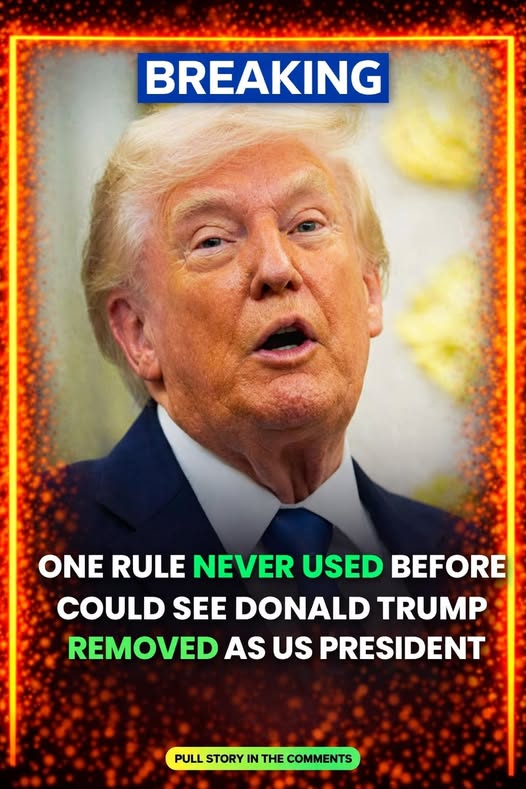
A political tremor is echoing through Washington, and it didn’t come from the usual opponents across the aisle—it came from within the conservative world itself. At a moment when global tensions are already high and fears of escalation with Iran are intensifying, a shocking internal rupture has emerged: a veteran conservative voice is now openly suggesting that Vice President JD Vance should consider stepping into one of the most extreme constitutional scenarios imaginable—removing President Donald Trump from power.
The idea, once relegated to political fiction and academic debate, is suddenly being dragged into the harsh light of real-world discussion. Not through impeachment proceedings. Not through the ballot box. But through a dramatic and rarely invoked constitutional mechanism that many Americans have only heard of in theory: a direct appeal for intervention that could trigger the most severe transfer of executive authority in modern U.S. history.
At the center of this storm is Scott McConnell, whose argument has landed like a shockwave precisely because of who he is—not an outside critic, not a progressive commentator, and not a long-standing opponent of the MAGA movement. Instead, he is someone who once existed comfortably within the conservative intellectual ecosystem, now breaking ranks in the most explosive way possible. His warning is blunt and unsettling: the president, in his view, is being driven toward catastrophic decisions based on what he describes as unreliable or “BS intelligence,” and the normal political safeguards may no longer be enough to prevent disaster.
To McConnell, this is not ordinary political disagreement. It is an emergency signal—an alarm bell that, in his framing, justifies extraordinary constitutional action. He points toward the 25th Amendment as the final safeguard, the institutional “break glass in case of emergency” mechanism designed for moments when a president is deemed incapable of safely exercising power. In his view, the stakes are no longer theoretical. They are immediate, volatile, and potentially irreversible.
But translating that argument into action would require something almost unimaginable in today’s polarized Washington. It would place JD Vance in a position of historic consequence and political peril: confronting the very leader who elevated him, built part of his national platform, and reshaped the modern Republican coalition. It would mean attempting to persuade a cabinet—largely loyal, ideologically aligned, and personally chosen—to take the unprecedented step of declaring a sitting president unfit to continue in office.
The consequences of such a move would ripple far beyond the White House. Within the Republican Party, it would likely detonate years of fragile unity, splitting factions that have only recently consolidated under the MAGA banner. On the streets and online, it could ignite fury, disbelief, and potentially unpredictable backlash from a deeply energized political base. And in Washington itself, it could plunge the federal government into paralysis at the very moment international tensions are already pushing global systems toward the edge.
Supporters of McConnell’s warning see urgency where others see alarmism. They argue that inaction carries its own risks—that ignoring internal warnings could allow a preventable crisis to unfold unchecked. Critics, however, view the entire scenario as a dangerous escalation in political rhetoric, one that risks normalizing extraordinary constitutional intervention for partisan or interpretive disagreements.
What makes this moment so volatile is not just the argument itself, but its origin. It is coming from inside the ideological circle that has historically defended the president most fiercely. That alone has transformed a theoretical debate into a headline that feels charged with consequences.
And as tensions mount abroad and uncertainty deepens at home, McConnell’s central message lingers like a warning flare in the night sky: the system may still have safeguards—but whether anyone is willing to use them may determine how this chapter of American politics ultimately unfolds.