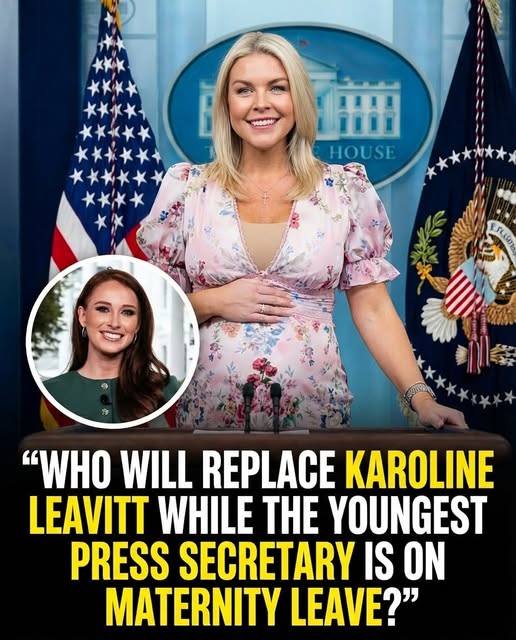
Washington is holding its breath in a way that feels almost theatrical, as though the entire political rhythm of the capital has paused for a moment that is at once deeply personal and quietly consequential. With Karoline Leavitt preparing to step away for maternity leave, the familiar cadence of the White House briefing room is suddenly shadowed by a question that rarely lingers so openly: who will step into the light when the podium goes quiet, and who will carry the weight of its scrutiny in her absence?
Behind closed doors, the conversation is less about personality and more about control, continuity, and the fragile balance of messaging in an election-year atmosphere where every word is measured, and every pause interpreted. The briefing room may look like a stage, but inside the West Wing it is treated more like a command center—one where tone, timing, and trust can shape national perception in real time. And now, that center of gravity is shifting, even if only temporarily.
At the forefront of this quiet succession discussion is Anna Kelly, already serving as Principal Deputy Press Secretary and widely seen as the most seamless continuation of the current operation. Known for her discipline under pressure and her deep familiarity with the administration’s messaging strategy, she is not just present in the room—she is already part of its rhythm. Senior aides trust her judgment, colleagues rely on her steadiness, and reporters have learned to read her expressions as carefully as her words, knowing that even the smallest shift in tone can signal a larger message being shaped behind the scenes.
Supporting that inner framework are figures like Taylor Rogers and Liz Huston, who help maintain the daily machinery of communication that rarely pauses, even when leadership temporarily steps aside. Their presence ensures that the transition, however it unfolds, will not feel like a rupture but rather a carefully managed handoff—an effort to preserve stability in an environment where instability is always just one headline away.
Beyond this immediate circle, other names circulate in quieter conversations—Kush Desai, Katie Pavlich, and Tricia McLaughlin—each representing slightly different shades of experience, perspective, and political instinct. Their mention is less about formal selection and more about possibility, reflecting the natural tension that arises whenever a visible role opens even temporarily: whether to maintain strict continuity or subtly recalibrate the tone for a changing moment in the political cycle.
Yet despite the speculation, this is not a power struggle or a dramatic reshuffling. It is, instead, a pause—brief, structured, and carefully contained. Leavitt is expected to return, stepping back into a role that demands constant presence and unwavering endurance, now carrying both the personal transformation of motherhood and the professional intensity of a position that rarely allows distance.
And in that intersection—between the nursery and the briefing room, between private life and public expectation—modern political power reveals itself in its most human form: not as a static position, but as something constantly negotiated, adjusted, and lived in real time.