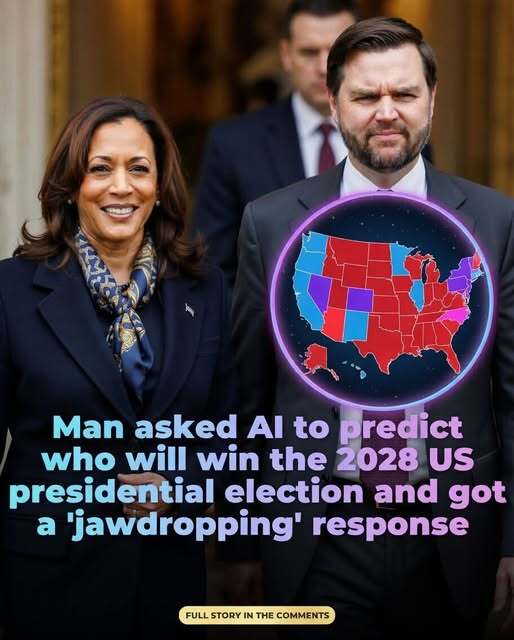
The numbers don’t just land—they detonate.
An election simulation powered by xAI, under the watch of Elon Musk, has quietly run a full-scale war game of the 2028 race—and what it reveals is enough to unsettle both sides of the aisle. This isn’t pundit chatter or partisan spin. It’s cold, pattern-driven analysis. And yet, the outcome feels anything but cold.
In this digital battleground, Kamala Harris steps forward as the Democratic frontrunner, backed by institutional gravity, national recognition, and the lingering infrastructure of an incumbent political machine. On paper, she looks formidable. But beneath that surface strength, the model detects fractures—subtle but persistent. A party not entirely unified. A base that hesitates in ways polling often fails to capture. The kind of internal tension that doesn’t explode loudly, but quietly erodes certainty.
Across the aisle, JD Vance emerges not as a surprise, but as a signal. The simulation doesn’t treat his rise as accidental—it maps it. His strength is rooted in something deeper: a cultural and economic realignment that has been years in the making. In the Midwest, in working-class regions once considered reliably blue, the data suggests a shift not just in votes, but in identity. Voters aren’t just changing preferences—they’re changing allegiances.
And then comes the moment that changes everything: the map locks.
The Electoral College doesn’t edge toward a narrow finish—it breaks wide open. Vance surges past 300 electoral votes. States long considered battlegrounds tip decisively red. Others, once assumed safe for Democrats, suddenly flicker with vulnerability. The familiar playbook—suburban turnout, demographic coalitions, historical trends—starts to feel outdated, like a strategy built for a country that no longer exists in quite the same way.
What makes this simulation unsettling isn’t just the winner. It’s the geography of the victory. The unexpected pathways. The quiet, almost invisible shifts that, when combined, redraw the entire political landscape. It suggests that the rules both parties rely on may already be obsolete—and they just haven’t caught up yet.
The creators are careful to frame it as one scenario among many. Not prophecy. Not prediction. Just a model.
But that’s what makes it linger.
Because if a machine, stripped of emotion and bias, is simply tracing the patterns we’re leaving behind… then the real question isn’t whether it’s right.
It’s whether it’s seeing us more clearly than we see ourselves.