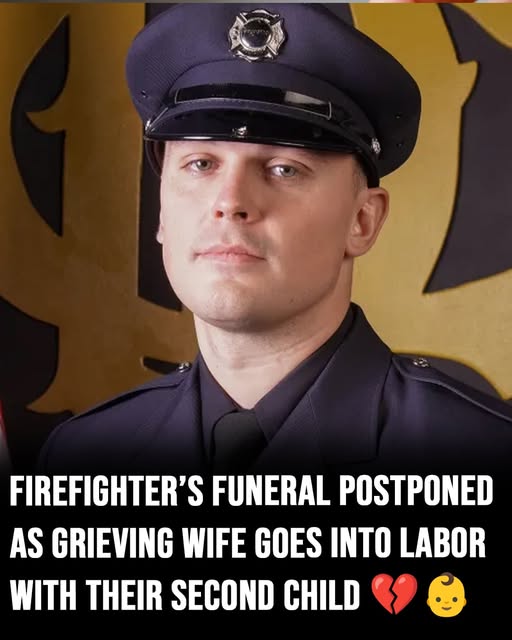
A siren wailed through the city one final time for him—long, low, and heavy with meaning, as if even the streets themselves understood what had been lost.
Chicago had gathered to say goodbye.
Uniforms stood in perfect rows outside the firehouse. Flags hung at half-mast, barely moving in the still morning air. The casket, draped in red, white, and blue, had been carried with slow precision by the men and women who once called him brother. Every detail had been prepared: the folded flag, the final salute, the speeches rehearsed too many times in trembling voices. It was supposed to be a moment of closure. A final chapter for a life defined by courage.
Firefighter Michael Altman was more than a name on a memorial wall. He was a fourth-generation Chicago firefighter—the kind of man who grew up hearing alarm bells the way other children hear lullabies. He ran into burning buildings while others ran out, not because he didn’t fear death, but because he understood exactly what it meant to protect life anyway.
And that day, during a relentless inferno consuming an aging structure on the West Side, he did what he had always done. He went in when others were pulled back. He moved through smoke so thick it swallowed light itself. And then the floor gave way.
Silence followed the sirens that day. The kind of silence that never truly leaves a department again.
Now, as the city prepared to honor him, his brothers and sisters in uniform stood rigid with grief, jaws clenched, eyes fixed forward because looking at one another might break them completely. His name would be spoken. His badge number would be retired. The final bell would ring.
Everything was ready.
Then everything changed.
A whisper moved through the crowd like electricity through metal wire—soft at first, almost unreal, then impossible to ignore.
His wife, Nora, was in labor.
For a moment, no one knew how to breathe.
Grief and hope collided in the same fragile instant. The funeral that was meant to mark an ending suddenly cracked open into something far more complicated, far more human. Officers glanced at one another as if searching for instructions that didn’t exist. How do you mourn a man while his child is arriving into the world he just left behind?
The ceremony was paused. Time itself seemed to hesitate.
Across the city, in a hospital room filled with quiet urgency, Nora Altman fought through pain and memory and love she could no longer reach. And then, as dawn pressed gently against the windows, their daughter arrived—tiny, breathing, alive.
Evelyn Rose.
A name chosen in hope long before tragedy ever touched it.
In the span of a single day, the Altman family experienced both the deepest rupture and the most impossible beginning: a husband laid to rest, and a child lifted into her first breath. A farewell and a welcome separated only by miles, yet bound together by everything Michael had been.
Back at the firehouse, the folded flag still waited. The bells would still ring. The honor would still be given.
But something had shifted.
Because now, when Chicago spoke Michael Altman’s name, it would not only remember how he died—but also what arrived in his final hours. A daughter who would grow up hearing that her father ran into fire so others could live. And a city that would forever remember the day grief and hope shared the same heartbeat.