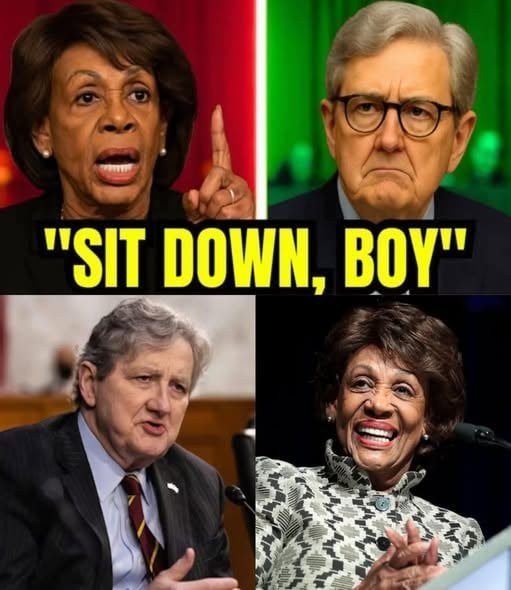
The room didn’t simply fall silent—it fractured into something heavier than silence, something almost physical. One command, three cutting syllables, and the entire atmosphere of the hearing seemed to buckle under its own tension. It was as if every unresolved fault line in American politics had suddenly been pressed at once, exposing raw edges no one in the room could comfortably ignore.
Staffers froze mid-note. Cameras tightened their focus, hungry for a reaction that never came quickly enough. Even the smallest movements—papers shifting, a chair creaking—felt amplified, like sound itself had become uncertain. For a few suspended seconds, no one fully committed to speaking, as though language itself had to be reconsidered before it could safely exist again.
Then Senator John Kennedy slowly removed his glasses.
That small gesture changed the temperature of the room more than any shouted exchange could have. He looked up, not with urgency or offense, but with a deliberate stillness that suggested he had already decided what kind of moment this would become. The insult hung there—visible, unchallenged, almost waiting to be detonated into the kind of viral confrontation modern politics often feeds on.
But he didn’t feed it.
Instead, Kennedy chose restraint. Not the passive kind that avoids conflict, but the intentional kind that redirects it. He neither snapped back in anger nor reached for sarcasm. He didn’t lean into the emotional energy that would have turned the exchange into instant cable-news fuel. His response was measured, controlled, almost unexpectedly calm—delivered in a tone that made it clear he would not accept the framing placed on him, but also would not grant it the satisfaction of escalation.
In that decision, something subtle shifted. The moment stopped being about an insult thrown in one direction and became about agency in the other. Kennedy reframed himself—not as someone defined by what was said to him, but as someone choosing how much power those words were allowed to hold.
Across the room, the impact was immediate but quiet. There was no dramatic applause, no interruption, no visible resolution. Just a collective awareness that the expected script had been denied.
The remark had come from Representative Maxine Waters, and like so many heated political exchanges, it did not stay contained within the chamber. It spread quickly beyond it, clipped, replayed, analyzed, and reinterpreted through every possible ideological lens. To some, her words represented justified frustration finally given voice. To others, they crossed a line that should not be blurred in public discourse.
But as the clip traveled, what people debated most intensely wasn’t only what was said—it was what didn’t happen afterward.
There was no eruption. No verbal retaliation. No collapse into the familiar rhythm of outrage and counter-outrage that usually defines such moments. Instead, there was restraint—and that restraint became its own kind of disruption.
In a political culture increasingly shaped by spectacle, Kennedy’s refusal to escalate turned into an unexpected form of confrontation. It forced everyone watching—supporters, critics, and casual observers alike—to sit with an uncomfortable question: was power in that moment expressed through dominance and reaction, or through control and refusal?
And long after the cameras moved on, that question lingered more loudly than the exchange itself.