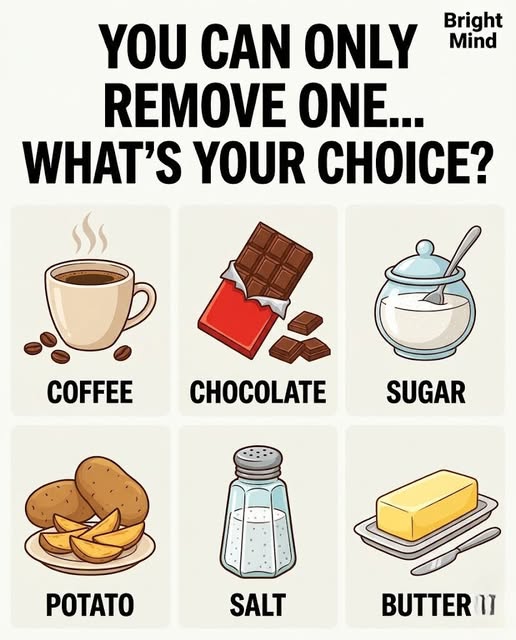
You think it’s just a game at first—something light, almost playful. A dinner-table prompt tossed into the air like a joke meant to keep the mood warm: “If you had to give up sugar, salt, bread, cheese… or nothing at all—forever—which would you choose?” People smile. Forks pause mid-air. Someone laughs too quickly, eager to fill the silence before it arrives. Answers come in fast, casual bursts—“I’d quit sugar, easy.” “Bread, no problem.” “I could live on cheese alone.” The conversation moves on, as conversations do.
But then something strange happens. The laughter thins. The rhythm breaks. A small, almost invisible silence settles over the table—not dramatic, not obvious, but heavy enough to make everyone suddenly aware of their own thoughts. Because the question was never really about food.
It was about control.
About comfort.
About what you rely on when no one is watching.
And once that realization slips in, it changes the meaning of everything that was said before.
Because you’re no longer choosing between ingredients—you’re choosing between versions of yourself.
If you give up sugar, you’re not just rejecting sweetness. You’re hinting at discipline, at someone who can resist immediate pleasure for a future that hasn’t arrived yet. It suggests a quiet strength, the kind that doesn’t announce itself but shows up in long-term decisions, in restraint, in delayed satisfaction that no one applauds in the moment.
If you give up salt, it feels different. Subtler. Almost philosophical. It suggests someone who doesn’t need constant enhancement to experience life fully. A person who can sit with things as they are—unfiltered, unadjusted, unmasked—without needing to intensify them just to feel alive.
Bread is heavier still. It’s comfort, memory, routine. To give it up is to challenge your attachment to the familiar—the warm, dependable things that anchor your days. It raises a quiet question: are you willing to let go of emotional security if it no longer serves your growth?
Cheese, on the other hand, feels indulgent, emotional, even nostalgic. To surrender it is to step away from small pleasures that make life feel rich and human. It asks whether you can choose balance over comfort, clarity over craving, intention over impulse.
And then there are those who refuse the premise entirely. “I wouldn’t give up anything.” It sounds simple, even stubborn—but it carries its own weight. A quiet declaration of autonomy. A refusal to let imaginary rules define real boundaries. A belief that life should not be reduced, negotiated, or narrowed down by someone else’s question.
What makes the moment linger is not the answer itself, but what it reveals. People don’t just reveal preferences—they reveal priorities, limits, identities they didn’t even know they were exposing.
By the time the plates are cleared and the conversation drifts elsewhere, the question doesn’t leave. It follows quietly, like a shadow tucked inside thought.
Because once you’ve been asked to sacrifice something—even hypothetically—you start to wonder:
If life ever demanded more than a casual choice, which parts of yourself would you protect… and which parts would you be willing to let go?