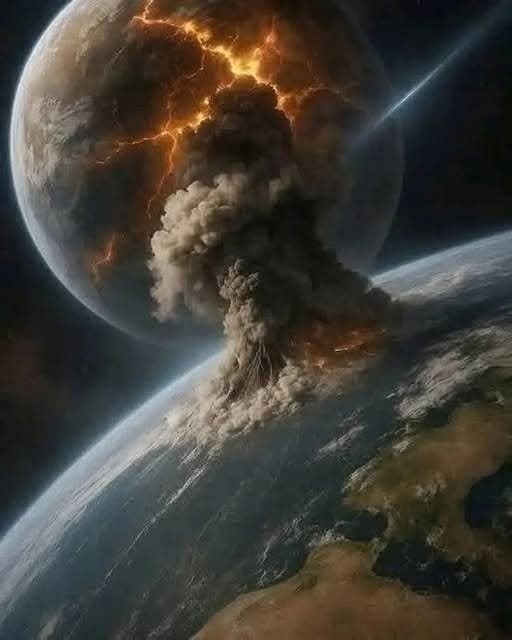
The warning arrived almost politely—quiet, clinical, wrapped in scientific calm—but the reality behind it carries no such softness. A mountain-sized asteroid is passing close to Earth, sliding through the dark with the kind of mass that makes numbers feel suddenly inadequate. Scientists assure us there is no impact, no danger, no reason to lose sleep. Yet beneath those reassurances lingers an uncomfortable truth: space does not negotiate, and certainty is always conditional.
This is asteroid 52768 (1998 OR2), a colossal traveler from the distant edges of our solar system, now sweeping past our planet on a path that will miss us by millions of kilometers. “Harmless,” they say. “Well understood,” they add. But its presence still provokes something deeper than curiosity. It forces us to confront how thin the line truly is between routine cosmic flybys and catastrophic collision—between a safe today and a rewritten tomorrow.
Because what feels like reassurance is also a reminder. Every calculation that predicts its safe passage depends on years of observation, layers of modeling, and the fragile precision of instruments we continue to improve but never fully perfect. We celebrate these achievements, and rightly so. Humanity has learned to track the sky with astonishing accuracy. But behind the confidence of press releases and trajectory maps lies a quieter reality: we are still playing catch-up with a universe that moves on its own terms.
This asteroid, enormous and indifferent, exposes the architecture of our preparedness. Detection systems are improving, but still uneven. Planetary defense programs exist, but often depend on funding cycles, shifting priorities, and international coordination that is more aspiration than guarantee. Even as telescopes scan the heavens every night, there remain blind spots—moments when something could appear too late, or be noticed just after the window to act has closed.
And so this close pass becomes more than an astronomical event. It becomes a rehearsal we did not stage, a demonstration offered freely by nature itself. No alarms. No damage. No cost—except the opportunity to pay attention. It shows us, in the safest possible way, what it would mean if something that size were aimed just slightly differently, or detected just slightly too late.
We are, for now, protected by mathematics, timing, and probability. But those safeguards are not shields; they are expectations. They assume continued vigilance, continued investment, continued cooperation between nations that do not always agree on much beyond the fact that the sky is large and unpredictable.
The question this passing giant leaves behind is not whether we survived it—we did—but whether we will learn from it. Whether we will strengthen the systems designed to watch for the next visitor. Whether we will build faster responses, better technology, and stronger global coordination before experience forces our hand in a far more unforgiving way.
Because space does not need to be frequently dangerous to be permanently dangerous. It only needs to be right once.