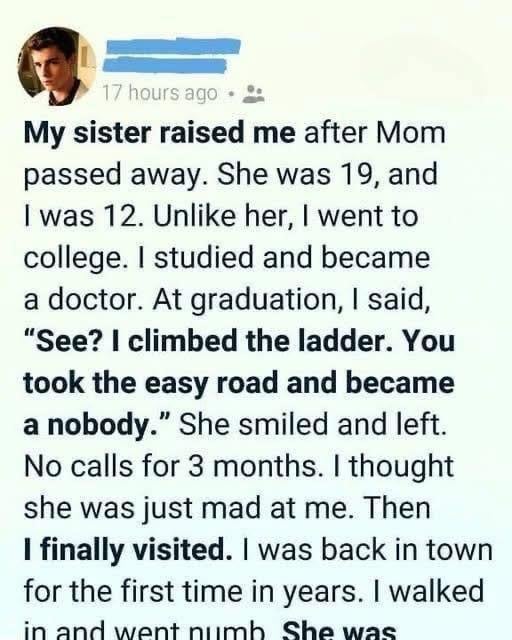
The day I finally “made it” was the same day I shattered the only person who had never once stopped believing in me. It happened so quietly, so carelessly—just one sentence, seven thoughtless words spoken in passing—yet it carried the weight of a lifetime. In that instant, everything she had given, every sacrifice she had buried without complaint, was erased in the shadow of my pride.
I remember believing I had arrived. Success, I told myself. Stability. Purpose. I thought I understood what love looked like, what duty demanded, what family meant. I was wrong in ways I didn’t yet have the humility to recognize. Because by the time I stepped back into that house—the one that had always felt like shelter—it was already too late. Something in it had gone still, as if the walls themselves had learned what I had not yet dared to face.
Growing up, I saw my sister as someone simply fulfilling responsibilities, doing what “needed to be done.” I never questioned the cost of that quiet endurance. While I chased grades that glittered on paper, internships that sounded impressive, and a future stamped with my name like a promise, she was building mine in silence. She worked extra shifts when no one was watching. She skipped meals and called it nothing. She wore out her strength the way others wear out shoes—until there was nothing left to replace.
And I, blind in my ambition, called it “the easy road.” I said it without understanding. Worse, I said it without trying to understand. I never saw how many of her dreams were set aside so mine could stay intact. I never noticed how often she chose my future over her own present. Every step I took forward was paved by her exhaustion, and I walked on it like it was simply the ground beneath me.
That night, standing in the stillness of that heavy house, I finally saw what I had spent years refusing to look at. The truth wasn’t dramatic. It didn’t announce itself. It simply existed—quiet, undeniable, everywhere. My success was not just mine. It was stitched together with her sleepless nights. The white coat I once wore with pride felt different in that moment, as if I could feel the weight of every hour she had given up to make it possible. The framed diploma on my wall no longer looked like achievement; it looked like a ledger of everything she had sacrificed without ever asking for credit.
I cannot undo the moment I chose pride over gratitude. I cannot take back the words that broke something between us. But I can decide what comes after the silence. I can choose to live in a way that does not repeat that blindness. To make my life a quiet acknowledgment of hers. To carry forward what she gave me—not as a burden, but as responsibility.
And if I ever learn how to honor it properly, it will be by living differently: loving without expectation of reward, giving without waiting to be seen, and remembering that the truest form of devotion is often the one that never asks to be acknowledged at all.