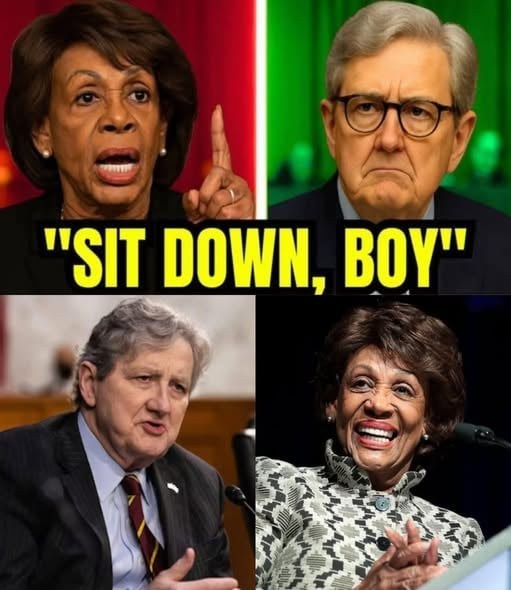
The room didn’t simply fall silent—it fractured under the weight of what had just been said. The air shifted, thick and electric, as if something invisible had split straight through the center of it. One command—sharp, unyielding, impossible to ignore—echoed like a fault line ripping open beneath the fragile surface of American politics. Conversations died mid-breath. Staffers froze, eyes darting, unsure where to land. Cameras zoomed in instinctively, hungry for the moment that would define the day, maybe even the week. No one moved. No one dared to break the tension. It wasn’t just quiet—it was rupture.
And in the middle of it all, John Kennedy sat still.
Slowly, deliberately, he removed his glasses. The gesture was small, almost unremarkable, yet it carried a gravity that pulled every eye in the room toward him. He looked up—not with fury, not with humiliation, but with something far more unsettling: control. In that suspended second, when expectation screamed for retaliation, for spectacle, for something loud and explosive, he chose something else entirely. He chose an answer no one in that room was prepared for.
He let the insult linger.
He didn’t rush to bury it under sharp words or clever comebacks. He didn’t meet fire with fire. Instead, he allowed it to exist in the space between them, heavy and undeniable—then refused to let it define him. There was no flash of anger, no sarcastic jab designed to win headlines, no wounded outrage seeking sympathy. What came instead was measured. Intentional. Almost disarmingly calm.
His response was quiet, but it wasn’t weak.
It was strategic in a way that felt deeply human—an understanding that sometimes the loudest statement is the one that refuses to perform. By choosing restraint, Kennedy denied the moment its expected climax. He withheld the confrontation that cable news thrives on, the kind of explosive exchange that gets replayed in endless loops, dissected, amplified, and weaponized. He stepped outside the script everyone assumed he would follow.
And in doing so, he rewrote the scene.
What could have been a moment of humiliation became something else: a demonstration of agency. He was no longer just a man being spoken to—he became a man deciding how he would be seen. Not reactive, but deliberate. Not diminished, but composed. His calm didn’t erase the insult, but it reframed it, shifting the focus from what was said to how it was answered.
Meanwhile, the words that sparked it all didn’t stay in that room.
They spread—fast and far—ricocheting across headlines, social media feeds, and dinner table conversations. They became more than just a remark; they turned into a national Rorschach test. People heard them through the lenses of their own beliefs, their own experiences. Some saw justified anger, long overdue and unapologetic. Others saw a line crossed, a breach of respect that couldn’t be excused. The divide wasn’t just political—it was personal, emotional, deeply rooted.
But as the debate grew louder, something unexpected lingered beneath it all.
Not just the words—but the response.
In a culture that feeds on spectacle, where outrage is currency and volume often masquerades as strength, Kennedy’s restraint stood out in stark contrast. It was, in its own way, confrontational—not because it attacked, but because it refused to play along. It forced a different kind of reckoning. Not just “Who was right?” but “What do we reward?” “What do we amplify?” “What kind of strength do we actually respect?”
Because in the end, the moment wasn’t just about an insult.
It was about power—who claims it, who loses it, and who quietly redefines it without ever raising their voice.