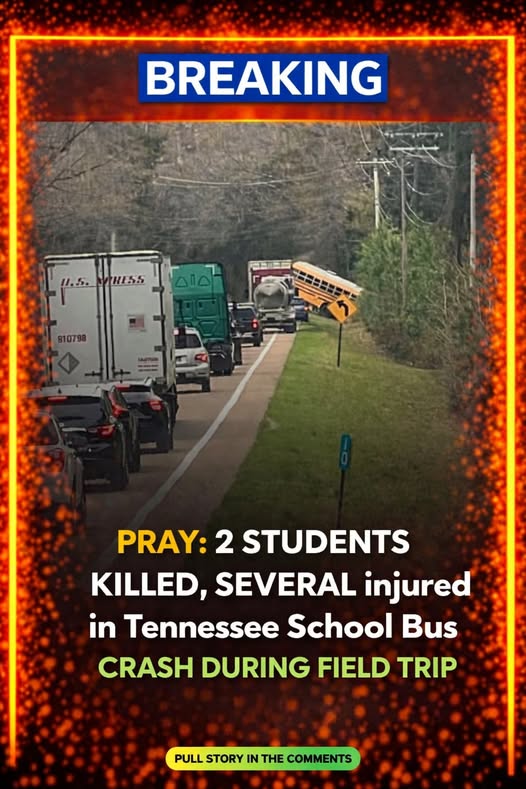
Two children never made it home.
It happened in the middle of an ordinary day—sun high, traffic steady, the kind of noon hour that passes without notice. A school bus carrying bright, curious STEM students, a TDOT dump truck, a Chevy Trailblazer, and a stretch of Highway 70 all converged in a single, irreversible moment. What followed was not just a crash, but a rupture—one that first responders would later say etched itself into memory in ways they could not shake. Helicopters cut through the sky in urgent circles. Sirens stitched together the silence. And across nearby towns, parents stared at their phones, waiting for calls that came too slowly, or worse, not at all. Officials asked for prayers. A community braced itself for the kind of grief that arrives without warning and refuses to leave.
They were supposed to spend the day chasing ideas, not fighting for their lives.
The trip had begun with excitement—a Kenwood Middle School outing to a GreenpowerUSA event, where young minds would test their creativity, their teamwork, their sense of possibility. It was meant to be a day of building, racing, dreaming. Instead, it ended in twisted metal scattered across the highway. Two students were pronounced dead at the scene, their futures stolen in an instant. Others were lifted into helicopters or rushed into ambulances, their injuries serious, their families thrown into a nightmare no one prepares for. The bus driver, a steady presence in their daily routines, now fights for life in critical condition. Behind the scenes, investigators work carefully, reconstructing the final seconds before impact—searching for answers that will never feel sufficient.
In Carroll and Montgomery counties, grief has settled in like a heavy fog.
It sits at kitchen tables where dinner goes untouched. It lingers in the quiet spaces between words, in the long pauses after someone says a name that will never again be answered. Parents replay their morning goodbyes, searching for something they missed—one more hug, one more “I love you.” Teachers stand at the front of classrooms, facing desks that will remain empty, wondering how to explain the unexplainable. First responders, trained to move through chaos, now carry images they cannot easily put down, their nights restless with memory.
Leaders offer statements, promises of support, resources to help mend what can be mended. But the real work of healing begins in smaller, quieter ways. It’s in neighbors knocking on doors just to sit together in silence. In counselors helping children make sense of fear they don’t yet have words for. In communities wrapping themselves around the families most deeply broken, holding them up when standing alone feels impossible.
And in time—slow, uneven, never complete—there will be a way forward.
Not a return to what was, because that is gone. But a new path shaped by remembrance, by love that refuses to fade, by the determination to carry forward the light of the ones who didn’t make it home.