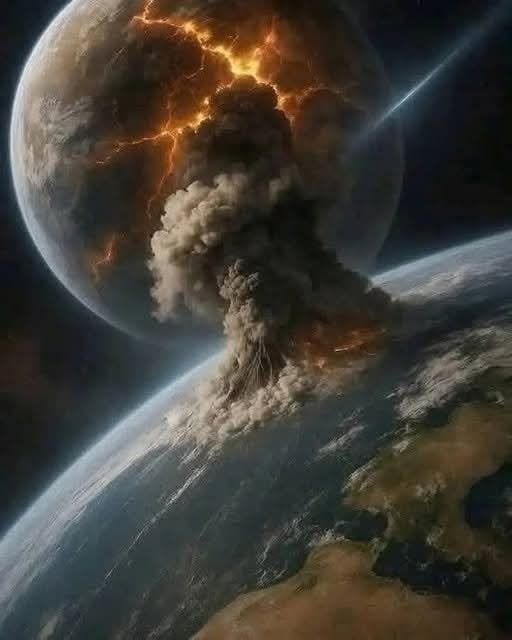
The warning didn’t arrive with sirens or flashing headlines. It came quietly, almost politely—wrapped in calm reassurances and careful language. Scientists told us there was nothing to fear, that everything had been calculated, that the margins were safe. And yet, somewhere behind that calm, an older, more instinctive voice stirred—the kind that understands scale, distance, and the uneasy truth that space does not negotiate.
A mountain-sized visitor is gliding past Earth.
We’re told to relax.
No impact. No danger. No reason to panic.
But size has a way of speaking louder than reassurance ever can.
As Asteroid 52768 (1998 OR2) sweeps through the darkness on its silent trajectory, it doesn’t roar or blaze or announce itself with drama. It simply passes—massive, indifferent, ancient. A relic from the early solar system, older than continents, older than life itself. And in that quiet passage, it reveals something unsettling: not danger, but vulnerability.
Because what we’re really witnessing isn’t just a harmless flyby. It’s a demonstration—a reminder of how narrow the margins can be.
We celebrate the precision of orbital mechanics, the brilliance of astronomers who can predict the path of a distant rock down to the kilometer. We trust the numbers, the simulations, the press releases that tell us everything is under control. And to a large extent, they’re right. This time, the math holds. This time, the timing works. This time, Earth is not in the way.
But beneath that confidence lies a race we are only just beginning to understand—and barely keeping pace with.
A race to see what’s out there before it’s too late.
A race to fund the telescopes that scan the darkness night after night, searching for faint, fast-moving shadows.
A race to build systems that don’t just detect threats, but can respond to them—deflect them, disrupt them, or at the very least, give us time to prepare.
And perhaps most fragile of all, a race to coordinate a world that struggles to agree on far smaller problems, let alone a threat that comes from beyond it.
Our safety, for now, rests on a delicate balance: mathematics, vigilance, and a measure of luck we rarely acknowledge.
This close pass—this moment where something enormous comes near and does nothing—is not just a relief. It’s an opportunity. A gift, disguised as routine. A warning that doesn’t demand a price.
Yet history suggests we are not always good at learning from near-misses. When catastrophe doesn’t strike, urgency fades. Budgets shrink. Attention drifts. The extraordinary becomes ordinary again, filed away as just another event that “was never a real threat.”
But that’s the illusion.
Because the universe doesn’t operate on our timelines or our attention spans. It doesn’t care about funding cycles or political disagreements. It doesn’t issue second warnings out of courtesy.
It is vast. It is patient. And it is filled with objects like this one.
Some larger.
Some faster.
Some still unseen.
So the question this moment leaves behind isn’t whether we were ever in danger today. We weren’t. The calculations are sound, the path is clear, and Earth remains untouched.
The real question is quieter—and far more important:
What will we do with the warning we didn’t have to pay for?
Will we invest in better detection systems that can spot the next object years, not weeks, in advance? Will we strengthen planetary defense programs so they exist not just in theory, but in readiness? Will nations find a way to cooperate before cooperation becomes a necessity forced by crisis?
Or will we do what we so often do—breathe a sigh of relief, look away, and wait?
Because one day, there will be another object. And another after that.
And eventually, one of them will not miss.
The universe only needs to be right once.