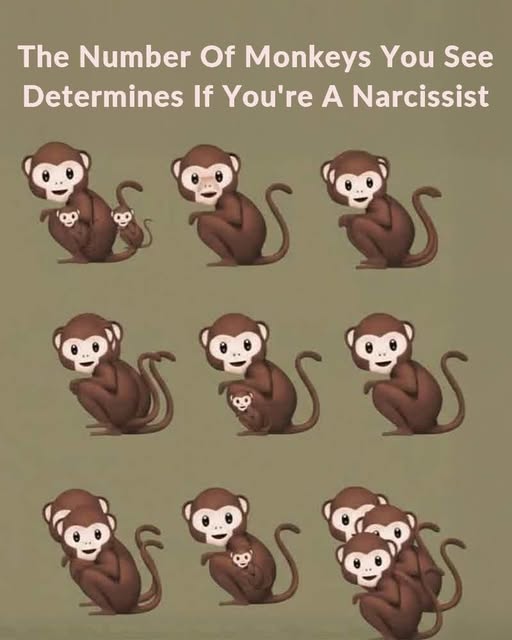
At first, it feels like nothing more than a passing distraction. A clever little monkey puzzle. A viral caption engineered to catch your eye as you scroll. You almost smile at it — harmless, playful, forgettable. Just another trick of the internet designed to steal a second of your time.
Then you read the claim.
The number of monkeys you see reveals something about you. Not just anything — something personal. Something psychological. A quiet label slips into the frame: narcissist.
And suddenly, it isn’t so harmless anymore.
You look again.
You count.
Once. Twice. Maybe a third time, just to be sure.
Did you miss one? Are others seeing more than you? Or less? You hesitate, caught in that strange space between curiosity and unease. Because now it’s no longer just an image — it’s a question. And worse, it feels like a question about you.
Before you even realize it, the puzzle has done its work. It has turned your attention inward. It has made you doubt your own perception. It has nudged you into comparison — with strangers, with imagined answers, with a version of yourself you’re not entirely sure you understand.
And that quiet tension you feel? That tightening in your chest or the flicker of second-guessing in your mind?
That’s the real trick.
Because what this image actually exposes has nothing to do with narcissism at all. It reveals something far more universal — and far more human.
It reveals how deeply we want to understand ourselves… and how quickly we’ll accept shortcuts that promise to explain us.
A simple cartoon becomes a mirror, not because it reflects truth, but because we want it to. We want to believe that something so immediate — a glance, a number, a split-second reaction — could unlock the complexity of who we are. That identity could be distilled into something neat, fast, and definitive.
But it can’t.
And yet, that hunger for instant clarity is exactly what these viral hooks are built to exploit. They don’t need to be accurate. They only need to feel personal.
Still, hidden beneath the clickbait, there is a quieter, more honest truth.
You do see the world differently than anyone else.
Not in a way that defines you with a single label, but in a way that shapes everything you experience. Your attention moves in its own patterns. You notice certain details instinctively while others slip past unnoticed. You construct meaning from fragments — from what stands out, from what lingers, from what feels important in the moment.
Someone else might see more monkeys. Or fewer. Or something entirely different.
And none of that makes either of you more flawed or more enlightened.
It simply makes you human.
So maybe the real power of the puzzle isn’t in what it claims to diagnose, but in what it quietly invites. That brief pause. That second look. That moment where you realize your first impression isn’t the full picture — just the beginning of it.
Because what you see first is only a fraction of what you’re capable of seeing.
And who you are?
That can never be reduced to a number hidden inside a cartoon.