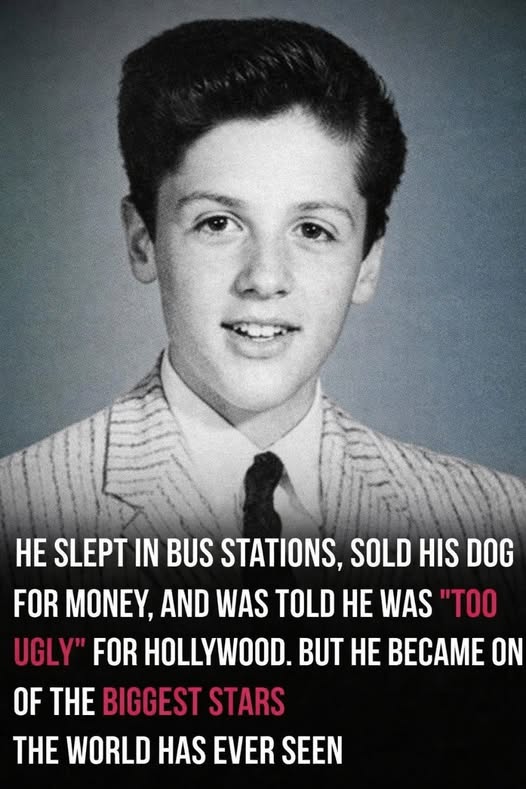
He was so broke he sold the only creature that loved him without question. So rejected he learned the geography of bus stations by heart—their cold floors, their flickering lights, the way night stretches when you have nowhere else to go. So dismissed that powerful men in polished offices tried to buy the one thing he had left—his dream—and cut him out of it like an inconvenience. They laughed at his lopsided face, his slurred speech, his “impossible” ambition. To them, he wasn’t a future star. He was a cautionary tale.
But sometimes the world misreads the very thing that will define it.
Sylvester Stallone entered life already branded as “less than.” A birth complication left part of his face paralyzed, shaping the voice and expression that casting agents would later reject without hesitation. Teachers saw limitation. Classmates saw weakness. Industry professionals saw risk. Everywhere he turned, there was a quiet consensus: this man would never fit the mold.
What they didn’t see was the fire building behind that uneven smile.
Acting wasn’t a pastime—it was survival. It was the only place where he could reshape the narrative handed to him at birth. Every rejection carved deeper resolve. Every insult became fuel. Pain, for him, wasn’t something to escape. It was something to transform.
And then came the moment that changed everything.
Late one night, he watched a brutal boxing match on television—two fighters trading punishment long after logic said they should quit. It wasn’t just a fight; it was a story. A man refusing to fall, refusing to disappear, refusing to accept that he didn’t belong in the ring. Something in Stallone ignited. In a fevered, relentless burst of inspiration, he locked himself away and wrote the script that would become Rocky in just a few days.
It wasn’t polished. It wasn’t perfect. But it was real.
Studios saw the potential immediately—just not in him. They offered money, more than he had ever seen, on one condition: sell the script and step aside. Let a “real” actor carry it. Let someone more marketable, more acceptable, more normal take his place.
For a man who had slept in bus terminals and sold his dog just to survive, it should have been an easy yes.
It wasn’t.
He said no. Again and again. Bigger offers came. The pressure mounted. But he held the line with a kind of stubborn defiance that bordered on madness: he would sell the script—but only if he could star in it.
To the industry, it was absurd. To him, it was everything.
Because this wasn’t just a movie. It was his life on paper. The struggle. The doubt. The refusal to stay down when the world had already counted you out. If he gave that away, he would lose more than a role—he would lose himself.
So he risked it all.
What followed is the kind of ending no one writes anymore because it feels too improbable to be true. The film was made on a modest budget. The unknown actor with the “wrong” face stepped into the ring. And somehow, against every expectation, everything connected. The story. The performance. The heart.
The world didn’t just watch—it believed.
The film exploded into a cultural phenomenon, earning critical acclaim, massive success, and ultimately winning the Academy Award for Best Picture. The man they mocked became a symbol. The voice they dismissed became unforgettable. The dream they tried to buy became untouchable.
And in one of the most quietly powerful full-circle moments, Stallone tracked down the dog he had once been forced to sell—and bought him back.
Because the story was never really about boxing.
It was about dignity. About refusing to accept the roles others write for you. About standing your ground when everything in your life suggests you should fold. It was about proving that being underestimated isn’t a weakness—it’s an opportunity.
Sylvester Stallone didn’t just create a character who refused to stay down.
He proved that sometimes, the only way to rise… is to risk losing everything and refuse—completely, stubbornly, unapologetically—to be written out of your own story.