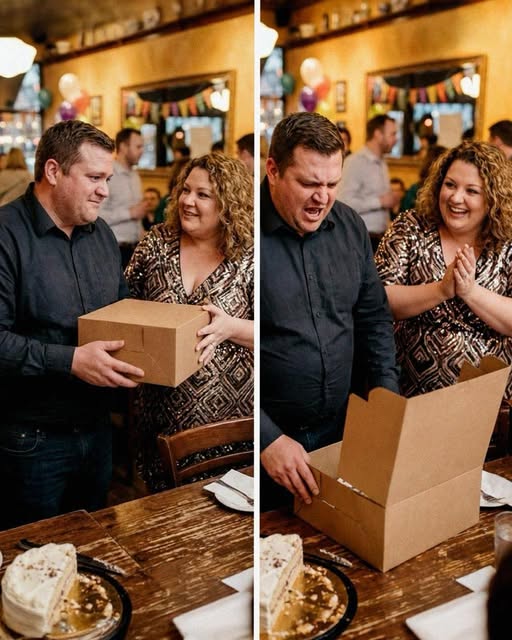
The room fell into a hush so sudden it felt unnatural, as if the air itself had been pulled tight. The candles flickered, untouched, their soft glow casting long shadows across faces that had just moments ago been lit with laughter. No one moved. No one spoke. At the head of the table sat a man who, until that instant, had been the center of admiration—confident, composed, unquestioned. And beside him stood the woman who had spent years shrinking herself to fit his shadow, now impossibly still, impossibly certain.
A husband, exposed in the most intimate way.
A wife, done with silence.
Children, frozen in the fragile space between innocence and understanding.
A mother, quietly unraveling in her seat.
And a room full of guests, each one realizing with a slow, creeping discomfort that they had never truly known the man they had come to celebrate.
Whitney had planned perfection. Every detail had been deliberate—the lighting, the music, the careful guest list curated to reflect the image her husband had spent years constructing. It was meant to be a night of admiration, a polished reflection of a life that looked enviable from the outside.
What she delivered instead was something far more precise. Not chaos. Not spectacle. But truth—sharp, undeniable, and impossible to look away from.
She hadn’t gone looking for this moment. She hadn’t woken up that morning with revenge in her heart. What she had wanted, once, was simple: to be loved without being diminished, to be seen without being reduced. But that version of hope had shattered quietly in a gym parking lot, under the harsh glare of afternoon light. A stranger’s forgotten phone. A message thread she should never have seen. And there, in cold, careless words, the man she had built her life around revealed himself completely—calling her “pathetic,” dismissing their children as burdens, reducing their shared life to something trivial and disposable.
The pain had been immediate, but it was the clarity that followed that changed everything.
For the first time in years, there was no confusion, no second-guessing, no bending herself into smaller shapes to make his behavior make sense. There was only truth. And in that truth, something within her finally stood upright.
In the quiet of her dining room, long before the party began, Whitney worked with a steadiness that surprised even her. She printed every message. Every insult. Every betrayal. She placed them carefully into a notebook, page after page, as though assembling not just evidence, but armor. Each sheet of paper was a piece of the voice she had been denied for so long. Each word, a reminder that she was no longer willing to live inside someone else’s narrative.
By the time the evening arrived, she was no longer uncertain.
At the restaurant, surrounded by polished glassware and curated smiles, her husband played his role flawlessly. He laughed too loudly, shook hands too firmly, performed the version of himself everyone expected. And for a while, it almost worked. The illusion hovered, fragile but intact.
Until Whitney stood.
She didn’t raise her voice. She didn’t cry. There was no dramatic flourish, no desperate plea for validation. Instead, she did something far more powerful—she gave him back his own words.
One by one, she read them aloud. Calmly. Clearly. Without embellishment.
The room shifted with each sentence. Laughter faded. Faces tightened. The man who had commanded the space only moments before began to shrink beneath the weight of what he could not deny. There was no argument he could offer, no charm he could summon to rewrite what had already been said.
And Whitney? She didn’t wait for apologies. She didn’t wait for understanding.
She chose herself.
Closing the notebook, she reached for her children—small, steady hands finding hers—and walked away from the table, from the performance, from the life that had been built on quiet diminishment. Behind her, the party unraveled into whispers and stunned silence, but she didn’t turn back to witness it.
Because for the first time, she didn’t need to.
What followed was not explosive. There were no grand declarations, no public battles. The aftermath unfolded in a different kind of strength—one that was quieter, but far more enduring. A life rebuilt not around someone else’s approval, but around her own sense of worth. A home that felt lighter, even in its uncertainty. Days that, while imperfect, no longer required her to disappear within them.
It wasn’t the ending anyone at that table had expected.
But for Whitney, it was something far more important.
It was a beginning.