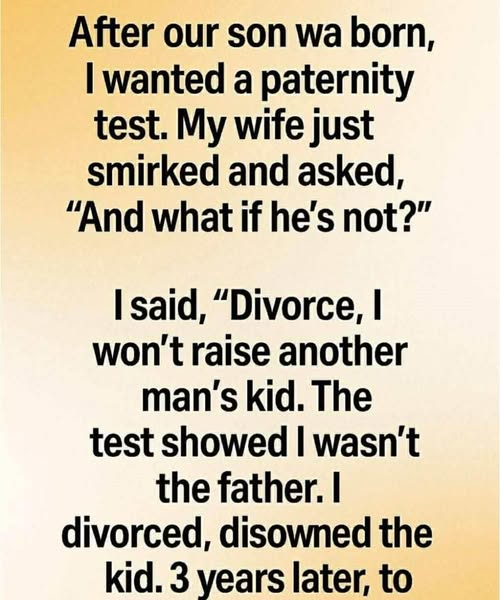
The moment he placed the box in her hands, something invisible but irreversible slipped between them—and quietly, almost politely, their marriage came to an end. There were no raised voices, no shattered plates, no dramatic exits. Just the soft weight of an envelope, a clinical sheet of paper, and a condition that felt colder than any argument: if the results weren’t what he needed them to be, he would walk away.
He told himself it was about truth. About certainty. About protecting his future from a doubt he could not name but could no longer ignore. In his mind, he was being rational, even responsible. But beneath that logic lived something far more fragile—fear that had been growing in silence long before that moment, long before the test, long before the child.
He never imagined the possibility that the test could be wrong.
He never imagined that the greater error would be his own.
Years later, what stayed with him wasn’t the document itself, but a room.
A small nursery painted in soft yellow—a color they had chosen together because it felt like hope. He would remember the way the afternoon light used to spill across the walls, the way the crib stood perfectly assembled in the corner, waiting for a life he once believed he might not claim. But that room would never again feel like a beginning. In his memory, it became something else entirely: the place where he chose suspicion over trust, distance over love, certainty over faith.
Time moved forward, as it always does. He built a life that, from the outside, looked complete—success, stability, a quiet kind of order. But solitude has a way of amplifying what we try to bury. And no amount of achievement could silence the echo of that single decision. The envelope he once trusted as truth became a symbol of something deeper. Because in the end, it was never just about science or results—it was about the doubt he had carried, the question he had allowed to define everything.
And then, one day, truth arrived. Not loudly, not dramatically—but undeniably.
A mistake. A lab error. A correction that came too late to change what had already been broken.
By the time he understood, by the time the weight of what he had done fully settled into his chest, his apologies had nowhere to go. They reached a door that no longer opened for him.
Emma had moved on—not in bitterness, but in strength. She had rebuilt her life piece by piece, not around his absence, but beyond it. What he had left behind, she had carried forward. What he had doubted, she had protected. And the child—the boy who once had a place waiting for him in that yellow room—grew up without knowing the man who had once carefully assembled his crib, only to walk away before ever truly becoming his father.
Sometimes, from a distance, he would watch them. From behind the windshield of his car, unseen, uninvited. He would notice the small things—the way she laughed, the way the boy moved, the life they had built without him. And in those quiet moments, the truth would settle deeper than any test result ever could.
Some choices do not end in arguments.
They end in silence.
And some bridges, once burned, are not meant to be rebuilt. Not because forgiveness is impossible—but because love, even when it forgives, is not obligated to return.