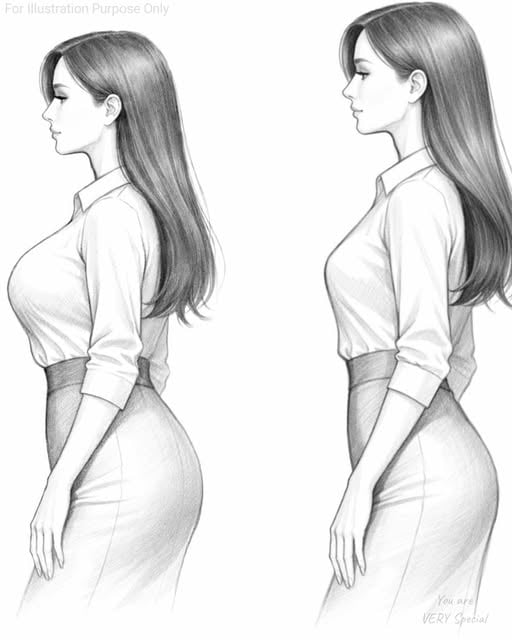
Breasts have never been just a body part in the eyes of the world. They’ve been turned into symbols, measurements, assumptions—quietly used to tell stories about a woman’s health, her femininity, even her worth. And for countless women, those stories have never felt entirely true… yet they linger, shaping how people look, how they judge, and how women learn to see themselves.
The truth is far less dramatic—and far more freeing.
Breasts are not a health report card. They don’t reveal whether your hormones are “balanced,” whether your body is thriving, or whether you fit some invisible standard of womanhood. Yet myths persist, passed down casually in conversations, media, and culture, feeding a quiet mix of shame, confusion, and self-doubt. A glance becomes an assumption. A size becomes a label. And suddenly, something natural is turned into something to question.
Science tells a different story.
Breast size is the result of a deeply individual combination of factors—genetics that you inherit without choice, hormones that shift across your lifetime, age, body weight, and even subtle elements of lifestyle. It is not a verdict. Not a diagnosis. Not a measure of how “complete” or “healthy” someone is. Medical evidence consistently shows that breast size does not determine hormonal balance, metabolic function, fertility, or emotional stability. In other words, it says almost nothing about the things that truly matter.
And yet, people keep looking for meaning where there is none.
Reducing a woman to a single physical trait erases the complexity of her body and her experience. Real health doesn’t live in appearances—it shows up in energy that carries you through the day, in menstrual cycles that reflect internal rhythms, in a resilient immune system, in restful sleep, in mental clarity and emotional steadiness. These are the quiet indicators of wellbeing, often invisible, but far more important than anything seen in a mirror.
There are nuances, of course. Some research has observed that women with larger breasts may show a higher association with conditions like type 2 diabetes—but this link is not about breast size itself. It’s connected to broader factors like overall body weight and fat distribution. The distinction matters. Because when misunderstood, correlation turns into blame, and bodies become unfairly judged for things they were never responsible for.
Every body is built differently. Variation is not a flaw—it’s the baseline of being human.
What actually shapes long-term health is far less visible and far more within reach: nourishing your body with balanced food, moving in ways that feel good and sustainable, allowing yourself real rest, and managing stress in a world that rarely slows down. These daily choices build a foundation that no superficial measure can capture.
And then there’s confidence—the part no study can fully define.
It doesn’t come from fitting a mold or meeting an expectation. It grows quietly when you stop treating your body like something to fix and start recognizing it as something that already works, already adapts, already carries you. Respect replaces comparison. Understanding replaces fear.
Because in the end, your body is not a symbol for others to interpret.
It’s a living, changing, resilient system—and it deserves to be understood, not judged.