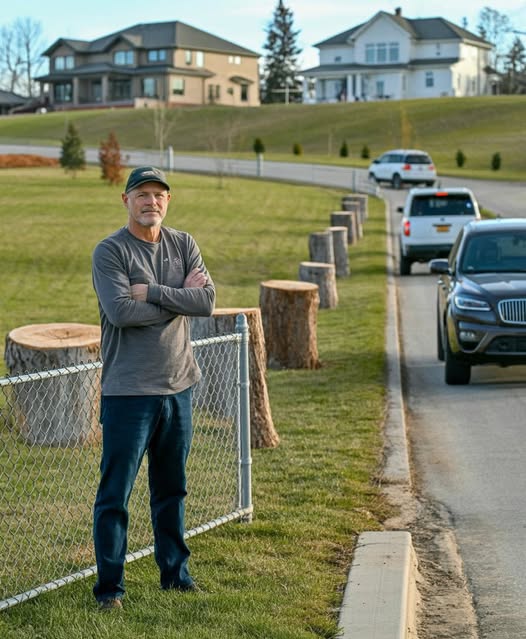
The first tree fell before he even had a chance to understand what was happening. One moment, the morning sun glinted off the leaves like it always had; the next, there was a crash that seemed to shake the sky itself. By the time he pulled into his driveway, forty years of his family’s history—the quiet markers of birthdays, anniversaries, and lazy Sunday afternoons—had been reduced to six clean-cut stumps. And beyond them, like a row of smug sentinels, stood the newly built million-dollar houses, their large windows and pristine façades staring down at what had once been his sanctuary.
The homeowners’ association called it a “view corridor.” He called his lawyer. The words felt almost comical, almost cruel in their simplicity, but his jaw was set, his hands trembling—not from fear, but from the cold, sharp pulse of anger and disbelief. That night, he barely slept, thinking about the letters, the surveys, the easements his grandfather had painstakingly secured decades ago. Every line of ink on those documents now glowed like a promise in his mind.
By dawn, he was back outside. A chain stretched across Pine Hollow Road, anchored by a padlock that gleamed in the weak morning light. He had parked his truck at an angle, just to make the point. The ridge’s residents emerged, dressed in crisp business attire, morning coffee in hand, faces flushed with irritation and disbelief. They didn’t take him seriously at first—the way people never quite believe you’ll actually wield the power you’ve quietly held all along.
But the chain was real. The padlock was real. And the easement, quietly tucked in the county records, was sharper than any saw or threat they could muster. While Cedar Ridge residents scrambled in group chats, emailed lawyers, and debated strategy over conference calls, the daily inconveniences began. Groceries took the long route over a winding gravel path. Commuters cursed under their breath as forty extra minutes were added to a trip that used to take fifteen. Small frustrations multiplied, and the hum of modern entitlement gave way to a quiet, simmering desperation.
Paper, it turned out, cut deeper than steel. The county survey confirmed every detail he had hoped for: the trees had stood firmly on his land, trespassed upon and stolen under the assumption that no one would challenge them. Legal letters piled up, citing timber theft, trespass, damages, and replacement costs. And then, one gray November morning, the first flatbeds rolled up, carrying twelve new sycamores. Cranes lifted them carefully, their roots settling into the same soil that had once cradled his father’s trees. He stood off to the side, a silent witness, waiting until the first trunk touched the earth before unlocking the chain.
Now, the ridge still has its sunset—but it’s a sunset framed through branches that will thicken, year after year, standing as both a shield and a reminder. A view no longer taken for granted, no longer assumed to exist for the pleasure of those who built above it. Every leaf, every shadow, every sigh of wind through the branches carries the weight of a lesson learned too late: nothing is owed, and nothing lasts without respect.