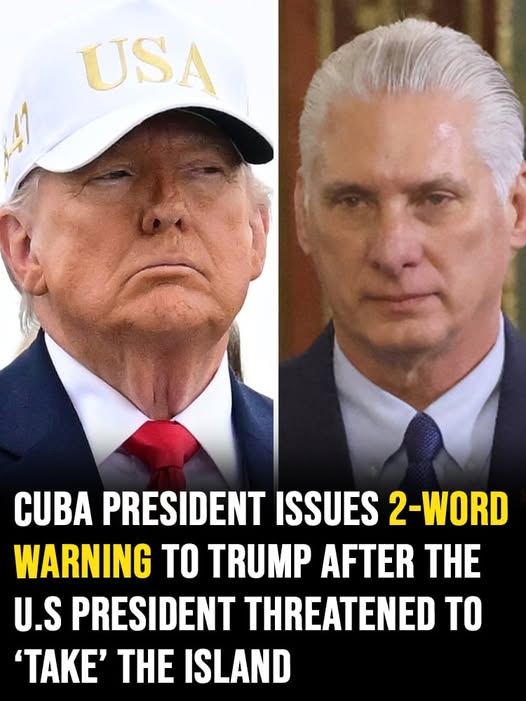
Tensions have finally reached a breaking point. In a storm of threats, bluster, and defiance, Donald Trump has publicly hinted that he could “take” Cuba — a remark that sent shockwaves far beyond Havana. But Cuba’s response was immediate, unmistakable, and chilling: a stark warning that reverberated across the Caribbean and rattled millions worldwide. In this new reality, words are no longer mere words. Every sentence is a signal, every tweet a spark, and every speech a potential fuse.
What unfolds now is a high-stakes standoff between two leaders locked in a dangerous and unpredictable dance. On one side stands the U.S. president, openly contemplating the idea of “freeing” or even “taking” a neighboring nation, signaling that the instruments of diplomacy — deals, sanctions, and pressure — could be cast aside for something far more forceful. On the other, the Cuban president meets the rhetoric with an ironclad defiance, promising that any attempt to topple his government would encounter unyielding resistance, even as ordinary Cubans face blackouts, shortages, and the gnawing anxiety of daily uncertainty.
Beneath the political posturing lies a haunting and urgent question: where does negotiation end and provocation begin? For Cubans, Trump’s words stir memories of intervention, isolation, and decades of hardship — a reminder that their island has always been a prize in a global chess game. For many Americans, the same words spark fears of another foreign crisis, a powder keg capable of spiraling far beyond control.
Now, between national pride, personal ambition, and the quiet desperation of ordinary citizens, both nations teeter at a crossroads. A single reckless step, a single miscalculated message, could transform this war of words into a confrontation whose consequences are no longer hypothetical. The world watches, tense and uncertain, as history once again threatens to repeat itself — only this time, the stakes feel higher, the margins slimmer, and the danger more immediate than ever before.