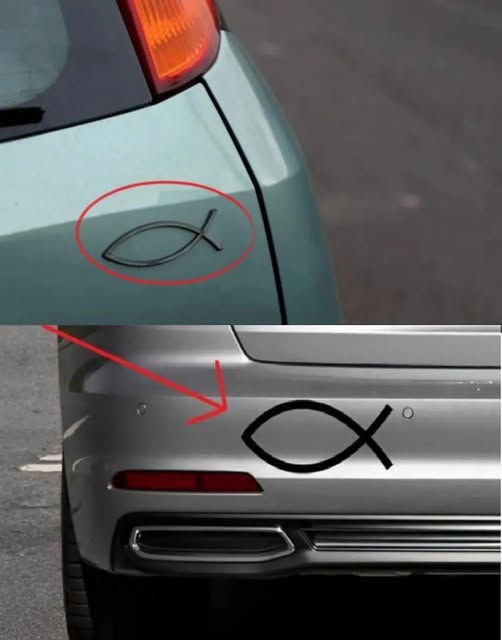
You’ve passed it a dozen times and hardly noticed. Then, one day, it catches your eye—and suddenly it won’t leave your mind. A tiny silver fish clings to the back of a stranger’s car, glinting subtly under the glow of brake lights, like a secret someone doesn’t want to explain. At first glance, it seems trivial, maybe even decorative. But the more you look, the more it unsettles you, because you realize it isn’t a brand. It isn’t a joke. It doesn’t belong to any trend, any fad, or any modern statement of identity. This little symbol is older than traffic, older than highways, older even than the very concept of the roads themselves.
What looks like a simple chrome sticker is anything but simple. It is the latest echo of an ancient symbol that has traveled across centuries and cultures. The fish, or Ichthys, first appeared among early Christians, drawn quietly in dust, carved into stone, or painted on hidden walls. In an age when openly declaring faith could be dangerous—even deadly—it served as a secret handshake between strangers who shared hope and conviction. “You are not alone. I see you. We belong to the same hope,” it whispered. Over generations, this emblem evolved beyond its original meaning, becoming less about secret allegiance and more about quiet virtues: patience, humility, and compassion. It never shouted. It never demanded attention. It simply existed as a gentle affirmation, a subtle marker of shared values.
Today, it has found a new home in the unlikeliest of places: on bumpers, hatchbacks, and the rear windows of cars weaving through chaotic city streets. Here, the fish carries a message just as delicate, just as profound. For those who display it, the gesture is often a promise to themselves more than a statement to the world. It is a reminder to breathe through the frustration of gridlock, to resist the siren call of road rage, and to remember that behind every wheel is a human being, struggling and striving just as they are. The emblem does not claim moral superiority. It does not guarantee divine protection. It simply softens the edges of a harsh, impersonal environment.
In the rush of horns and brake lights, amid the roar of engines and the anonymous crowd of commuters, that tiny silver fish glimmers like a quiet pulse of humanity. For a brief instant, it interrupts the flow of anger, the reflexive honking, the impatience. It asks nothing, demands nothing, but offers something rare: a gentle reminder that even in fleeting encounters—moments too short to be named—we can choose kindness over contempt, recognition over indifference, and respect over hostility. That small symbol, unnoticed by most, quietly endures, carrying a legacy that began thousands of years ago and continues, silently, on the road in front of you.