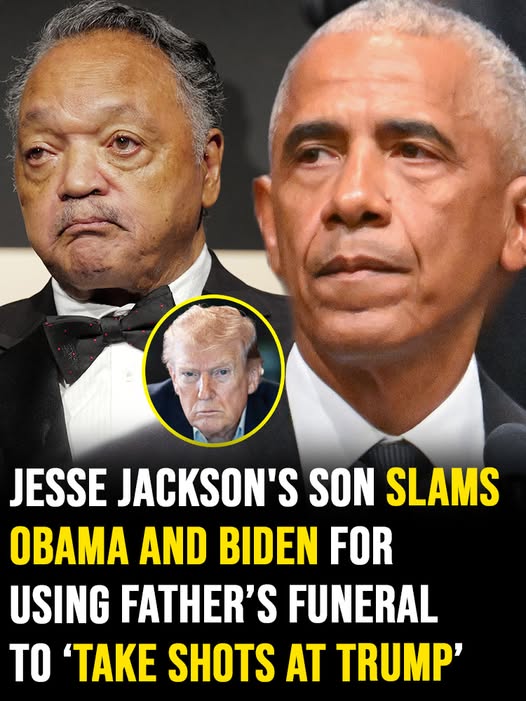
Jesse Jackson’s memorial became a storm the moment the spotlight hit the stage. In Chicago’s historic House of Hope, a city that had long been a backdrop to his tireless activism, the world gathered to honor a man who had walked alongside Martin Luther King Jr., challenged the corridors of power, and refused to let injustice rest unchallenged. Yet what should have been a solemn tribute to a towering civil rights figure quickly spiraled into controversy.
Three former presidents—barack obama, joe biden, and one other—took the podium to commemorate Jackson’s life. Their speeches were polished, reverent, and steeped in the language of politics, yet they did more than honor: they warned. Between eulogies, Obama and Biden threaded urgent reflections on democracy, social division, and the shadow of Donald Trump, transforming grief into a cautionary political statement. Applause echoed through the hall, but so did unease, a quiet murmur threading through a crowd gathered to remember moral courage, not partisanship.
For Jesse Jackson Jr., the reaction was immediate and visceral. At a quieter, private service the following day, he spoke with raw clarity. The presidents, he said, had missed the essence of his father. Jackson’s mission, he insisted, was never about party loyalty or political gamesmanship—it was about the “disinherited, the damned, the dispossessed, the disrespected.” To him, the prophetic fire of Jesse Jackson Sr.’s life—the uncompromising push for equality and justice—had been dimmed by the carefully measured words of national leaders.
Jackson Jr.’s words rippled beyond the walls of the service, sparking debate: can anyone truly frame the legacy of a man who refused to sell out his people? Barack Obama and Joe Biden have remained silent in the aftermath, leaving the question to hang like a shadow over Jesse Jackson’s legacy. Who, indeed, holds the authority to define the life of a man whose voice was always larger than any office, any platform, any speech? In honoring Jesse Jackson, the world glimpsed both his extraordinary impact and the deep complexities of remembering a life that refused to be simple, safe, or sanitized.