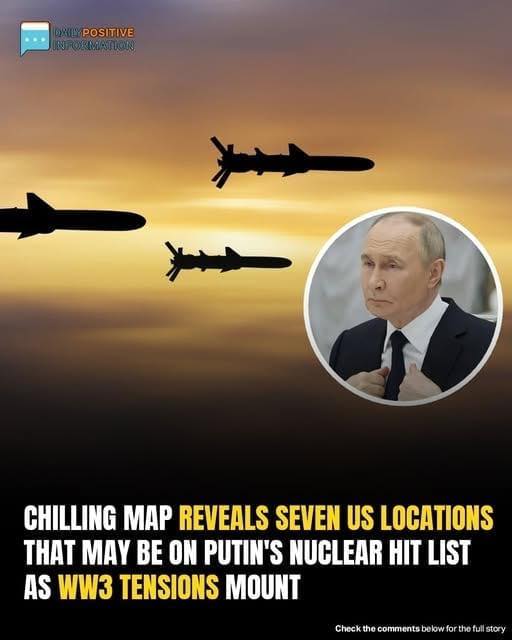
The warning didn’t arrive quietly, tucked into the shadows. It hit like a thunderclap, rattling nerves and igniting headlines: a so-called “doomsday map” now claims to outline the seven U.S. cities Vladimir Putin would strike first in a nuclear assault. In a world already on edge—where Iran and Israel trade missiles like grim tokens, and Ukraine burns under relentless bombardment—this is no longer a distant, abstract threat. It is tangible. It is intimate. It is American. It is now. The thought of sirens slicing through city streets, of fire and smoke blotting the sky, of ash drifting over landmarks once considered untouchable, is no longer confined to fiction.
Analysts and online forums have dissected the map with meticulous, grim fascination. The pattern it suggests is brutal in its logic: strike the head, paralyze the command; strike the heart, cripple the economy; strike the backbone, shatter the military. Washington, D.C., for command and control. New York, the financial engine. Norfolk and San Diego, the pillars of naval might. Omaha and Colorado Springs, guardians of nuclear and space operations. And Seattle or Los Angeles, gateways to the West Coast. Each red dot on the map is more than a target—it is a stark reminder of the vulnerabilities of a global superpower, laid bare and reduced to digital coordinates on a screen.
Yet, beneath the panic and the headlines, there lies a quieter, almost paradoxical truth. These maps, terrifying as they are, are crafted not as prophecies but as instruments of deterrence. The very precision, the vivid clarity of potential destruction, exists to prevent action, not provoke it. They are meant to freeze the hand hovering over the launch button, to make decision-makers weigh the consequences in icy, unflinching terms.
As tensions spike—Russia seething over U.S. support for Ukraine, missiles arcing over Middle Eastern skies—the world teeters on a knife’s edge. Survival, in this shadowed age of threats and counterthreats, rests on a single fragile principle: restraint. The hope is that leaders, staring into the abyss, will see reason before fear decides for them. Because once fear takes the helm, there are no maps, no warnings, no second chances—only the echo of what could have been.