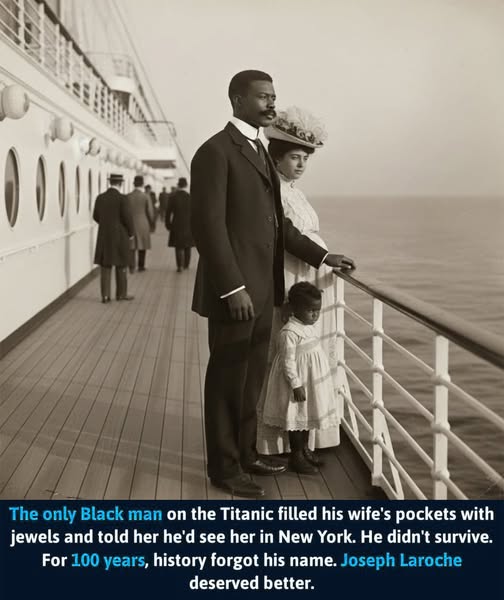
A brilliant Black engineer, Joseph Philippe Lemercier Laroche, stepped aboard the grandest ship ever built, a floating palace of steel and opulence, carrying nothing but a one-way ticket out of a country that had never truly seen him. France had admired his talent on paper but could not see past his skin. Employers offered him no work, opportunities slipped through his fingers, and the dream he had built with painstaking discipline began to crumble. And yet, for Joseph, the Titanic promised something more than escape—it promised dignity, a fleeting moment of belonging, a chance to sit at the same table as his young daughters, to feel the warmth of family above the rigid barriers of society.
Four days later, he was gone. No grave marked his passing. No newspaper carried his name. The world would remember the violins that played as the ship sank, the glitter of diamonds in first-class cabins, the captain’s tragic heroism—but it would forget him. For nearly a century, history erased the Titanic’s only Black passenger. His intellect, his love, his bravery, and the final, heart-shattering choice he made were buried beneath layers of myths about class, chivalry, and spectacle. There was no plaque in his honor. No chapter in the bestselling books. No mention in the films that grossed billions. Only a widow who carried grief in silence, a son who would grow up never knowing his father, and a single, faded photograph that would, generations later, demand remembrance.
Joseph had been raised to believe that talent and perseverance could outrun prejudice. He mastered multiple languages, studied engineering in France, and married Juliette, a French woman whose love for him burned fiercely and without reservation. Yet even with a brilliant mind and a steady hand, society offered him nothing but rejection. When financial pressures forced him to accept a teaching post in Haiti, it was a bitter compromise, a swallowing of pride in order to protect and provide for his family. Choosing the Titanic over a less luxurious vessel was a small, tender victory—a chance for his daughters to sit beside him at dinner, to share in the splendor he had been denied for so long.
When the iceberg shattered that fleeting illusion of triumph, Joseph faced a choice no parent should ever have to make. With calm courage, he counted the francs he had left, pressed them into Juliette’s coat, kissed his daughters goodbye, and stepped back to let their lifeboat descend into the freezing Atlantic waters without him. In that moment, he became invisible to history, swallowed by the sea and the stories that would outshine his quiet heroism.
It took decades, a stubborn widow, a son who pieced together fragments of memory, and that single, defiant photograph to bring Joseph Laroche back from the shadows. Today, he is remembered not as a nameless passenger lost in the annals of tragedy, but as a father and a man of extraordinary talent who made the ultimate choice for love. His life reminds us that history often overlooks those who do not fit the mold, but truth—like courage—cannot remain buried forever.