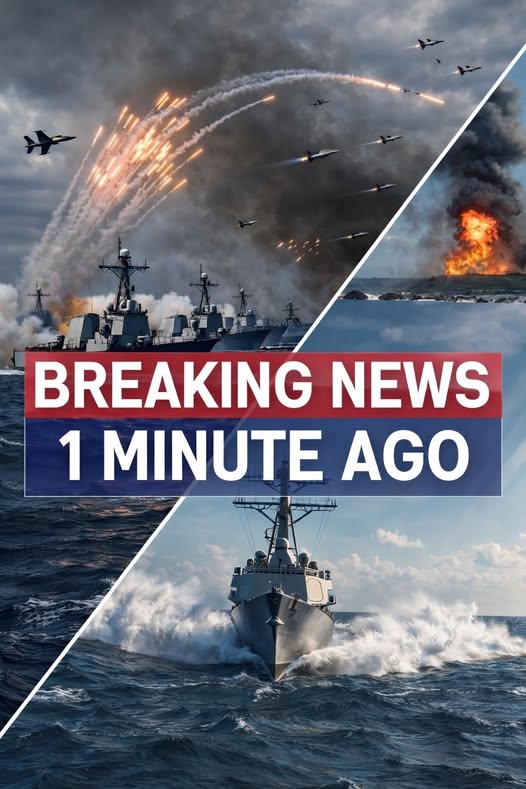
A dramatic confrontation unfolding in the Red Sea has sharply intensified tensions between U.S. naval forces and the Yemen-based Houthi movement, marking one of the most serious maritime escalations in the region in recent months. What began as a tense patrol in one of the world’s most strategically important waterways quickly turned into a high-stakes test of modern naval defense, highlighting how rapidly regional conflicts can spill into international waters and threaten global stability.
According to circulating reports, a U.S. naval destroyer operating in the contested shipping lanes of the Red Sea suddenly found itself under an extraordinary barrage of missiles. In what analysts describe as a carefully coordinated saturation attack, as many as 36 missiles were reportedly launched toward the vessel within a compressed time frame. The apparent objective was not simply to strike the ship, but to overwhelm its sophisticated layered air-defense systems through sheer volume and simultaneous pressure. Such a tactic is designed to push even advanced naval defenses to their limits—forcing radar systems, interceptors, and command crews to respond instantly to multiple incoming threats.
Military specialists say saturation attacks are among the most challenging scenarios a warship can face. By launching waves of projectiles in rapid succession, attackers attempt to strain detection systems and increase the likelihood that at least one missile slips through the defensive shield. Each incoming threat must be identified, tracked, prioritized, and intercepted in seconds. In the chaos of a real-time attack, even the most advanced systems depend heavily on the speed and coordination of the crew operating them.
Reports indicate that the American destroyer reacted immediately once the incoming missiles were detected. Defensive protocols were activated at once, and the vessel’s intercept systems engaged multiple targets under intense pressure. The encounter unfolded with breathtaking speed—within minutes, radar screens were flooded with signals, interceptors were launched, and electronic warfare measures were deployed. For those aboard the ship, the moment represented a stark reminder of how modern naval combat can transform a routine patrol into a life-or-death confrontation almost instantly.
Further accounts suggest that the situation evolved rapidly after the attempted strike. Within roughly twenty-two minutes, retaliatory actions reportedly shifted the operational environment. While precise details remain contested and independent verification is limited, several reports claim that rapid countermeasures targeted hostile launch infrastructure believed to be connected to the attack. If accurate, the swift response would illustrate how quickly military engagements at sea can trigger immediate counterstrikes across the region.
The episode underscores the fragile security environment surrounding one of the world’s most critical maritime corridors. The Red Sea serves as a vital artery for international commerce, linking the Mediterranean and the Indian Ocean through the Suez Canal and the Bab el‑Mandeb Strait. Millions of barrels of oil and vast quantities of global trade pass through these waters every day, making any military confrontation there a matter of worldwide concern.
Analysts warn that incidents like this demonstrate how quickly localized confrontations in the Middle East can escalate into broader strategic flashpoints. What begins as a single exchange of missiles at sea can ripple outward—affecting shipping routes, insurance markets, energy prices, and diplomatic relations across continents. In an era of increasingly sophisticated weapons and rapid-response military systems, the timeline of escalation has shrunk dramatically.
In the past, geopolitical crises often unfolded over days or weeks. Today, they can evolve in minutes. The reported attack and subsequent response highlight a stark new reality of modern conflict: a brief clash in contested waters can instantly reshape the balance of power, drawing regional actors and global powers into a rapidly intensifying confrontation.
For observers around the world, the Red Sea incident stands as a powerful reminder that the front lines of modern geopolitics are no longer confined to traditional battlefields. They now stretch across the oceans’ busiest shipping lanes—where technology, strategy, and split-second decisions can determine the course of events with global consequences. 🌍⚓🚢