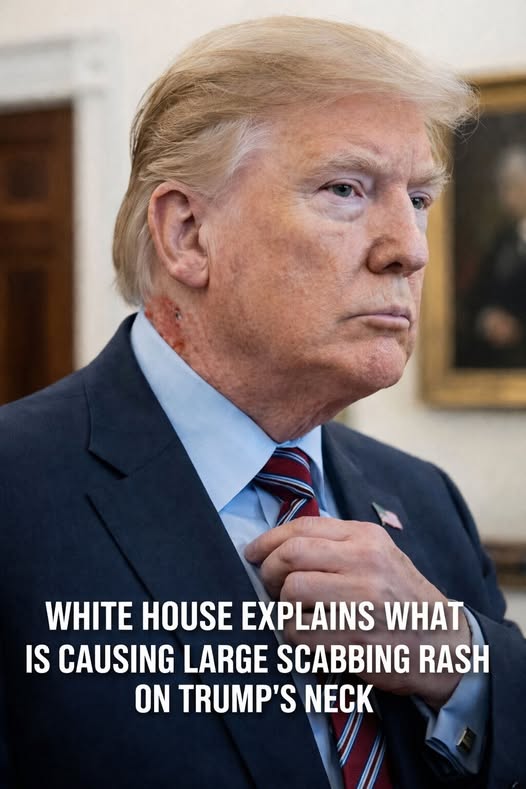
The photographs were impossible to overlook. Flecked across Donald Trump’s neck were angry, scabbed patches, stark against his otherwise composed appearance, captured during what was meant to be a solemn Medal of Honor ceremony. Within hours, the images had ignited a firestorm online and in the press. Was this a trivial skin irritation, the result of something mundane, or was it yet another sign that something more serious was unfolding behind the scenes? The public’s gaze, already sharpened by years of scrutiny, could not look away.
In response, Trump’s physician, Sean Barbabella, issued a carefully measured statement. He described the rash as the result of a “common topical cream,” a preventive skin treatment whose redness could persist for weeks. On the surface, the explanation seemed routine, almost banal—but it left critical questions unanswered. What exactly was being treated? Why did it appear now, at such a high-profile moment? Was this an isolated issue, or the latest signal in a series of subtle but telling health warnings? For a public primed to question every word coming from the White House, ambiguity is never benign.
Adding to the unease were previous images of Trump’s hands, bruised and often obscured under makeup, attributed alternately to daily aspirin use or the physical toll of endless handshakes. Observers noted episodes of visible drowsiness at public events, and the White House’s acknowledgment of his chronic venous insufficiency only deepened the sense of concern. Officials insist that these conditions are common, manageable, and of little consequence. Yet every fresh mark on his body, every momentary lapse in energy, chips away at the narrative carefully crafted for public reassurance.
In an era when leaders are read as much by their bodies as their speeches, Trump’s visible imperfections tell a story that press releases cannot fully control. Each scab, each discolored hand, each fleeting expression—real or amplified by speculation—feeds a collective curiosity and anxiety. For a nation that watches its president as both symbol and man, the tension grows between the official assurances and the instinct to read the subtle signs, to seek truth in flesh and bone where words alone fall short.