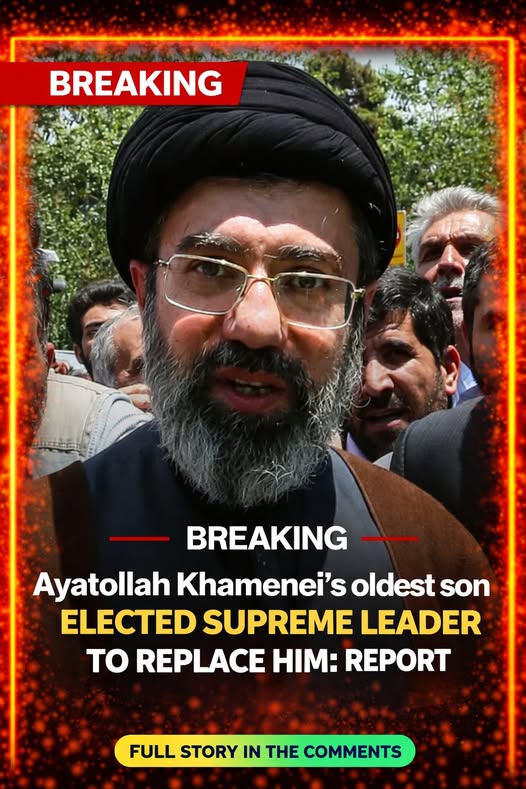
Missiles are still streaking across the night sky when the quietest, most consequential choice is made. Sirens wail, buildings burn, and somewhere far from the cameras, a handful of men gather behind guarded doors. In the corridors of power, whispers travel faster than rockets: the supreme leader’s son has been selected to guide a nation teetering on collapse. Clerics murmur prayers. Generals run scenarios. And 88 cloistered votes inside the Assembly of Experts may have just altered the trajectory of the Middle East.
If Mojtaba Khamenei truly ascends, it would mark one of the most dramatic pivots in the history of the Iran. Born from a revolution that toppled a king and denounced hereditary rule, the Islamic Republic was never meant to crown sons in place of fathers. Its founding mythology rejected monarchy as corruption and excess. Yet now, in the smoky aftermath of a decapitation strike and amid a storm of missiles, the possibility of dynastic succession hangs heavy in the air.
Behind closed doors, the calculus is ruthless. Stability over purity. Continuity over chaos. For some within the clerical elite, Mojtaba represents a known quantity — a man long rumored to wield influence behind the curtain, with deep connections to the powerful Islamic Revolutionary Guard Corps. In moments of national trauma, insiders often cling to familiar hands, even if those hands were never formally elected to lead.
But outside that guarded circle, the reaction is far less certain.
Iran’s constitution does not promise power by bloodline. The revolution of 1979 was, in part, a rebellion against inherited authority — against the idea that leadership could be passed like family heirlooms. To many Iranians, especially a younger generation raised amid sanctions, protests, and crackdowns, the elevation of a son may feel less like reassurance and more like betrayal.
They remember the long shadow of his father’s era — the prison cells, the suppressed uprisings, the lives upended in the name of ideological survival. They remember the promises of justice that hardened into iron control. For them, this moment is not just about geopolitics or succession mechanics. It is about whether history is looping back on itself.
Supporters inside the regime may frame it as resilience — proof that the system can endure even under fire. Critics will call it consolidation — the final sealing of power within a narrow, unaccountable circle. Allies will watch nervously. Rivals will calculate opportunity. Markets will tremble. The region, already stretched thin by proxy conflicts and fragile alliances, may feel the tremor long before any official announcement is made.
And still, confirmation remains elusive. In authoritarian systems, power often moves before words do. Decisions crystallize in silence, and by the time the public hears them, the machinery is already in motion.
If Mojtaba Khamenei steps fully into the light, he will inherit more than a title. He will inherit a country battered by isolation and internal dissent, a region bracing for escalation, and a population divided between fear, fatigue, and fragile hope. His leadership — whether seen as necessary continuity or unvarnished nepotism — will be tested not in ceremony, but in crisis.
In the end, the question is not merely who rules. It is what kind of republic emerges from this fire. Is this the preservation of a revolutionary state under siege? Or the quiet transformation of that revolution into the very dynasty it once condemned?
As missiles fall and rumors swell, Iran stands at a crossroads. And somewhere behind heavy doors and guarded walls, a decision that could echo for decades may already have been made.