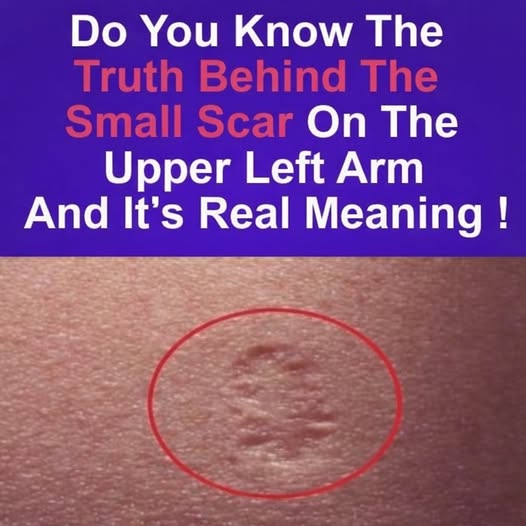
Some scars do more than trace the skin—they etch history into the body, a quiet reminder of the battles humanity has fought and survived. For decades, families carried a subtle, round dent on the upper arms of parents, grandparents, and great-grandparents. To the casual eye, it seemed innocuous, perhaps even quaint—a relic of a bygone era. But those tiny craters were anything but harmless. Each one told the story of a disease that once tore through towns, wiped out families, emptied villages, and cast a shadow of fear across continents. Each mark was a silent badge of survival, a muted warning of the fragility of life.
Long before it became a gentle curiosity on a fading arm, that circular scar began as a carefully inflicted wound, born from both desperation and hope. The smallpox vaccine did not arrive softly—it was pressed, pricked, and punctured into the skin, teaching the body to recognize and fight an enemy it had yet to meet. A blister formed, scabbed over, and left a permanent impression. It was more than medicine; it was a lesson in resilience written in flesh. That little mark was proof that the immune system had learned, that the body could remember, and that survival was possible even in the face of one of history’s most merciless killers.
Those who carry this mark are living witnesses to a world once gripped by constant threat, a time when a single cough or rash could become a death sentence. Yet the scar also tells a story of extraordinary human cooperation: of doctors venturing to the most remote villages, of scientists laboring in crowded labs, of communities choosing the sting of a needle over the heartbreak of loss. Each faded circle on an arm is a testament not just to individual survival, but to a collective triumph over fear.
Today, most of us bear no such mark, and in that absence lies another kind of victory—a quiet celebration of a nightmare ended. And yet, for those who still see the tiny circle etched on skin, it whispers across generations: humanity can confront even its oldest, deadliest adversaries. We can choose courage over despair, action over surrender, and hope over fear. If we dare to stand together, the scars of history can become the proof that nothing, not even the most relentless of threats, is insurmountable.