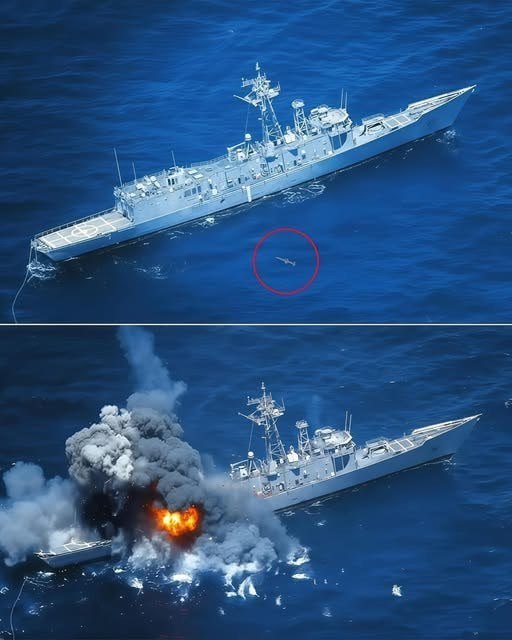
The former USS Rodney M. Davis (FFG-60) did not meet her end in the chaos of battle, nor beneath the shadow of enemy fire. Instead, after decades of vigilant service, the guided-missile frigate was given a final assignment—one last mission that would serve the future of the fleet she once helped protect. During a carefully coordinated SINKEX (sinking exercise), she was deliberately sent to the depths of the ocean, struck by a powerful AGM-84 Harpoon missile in a controlled test designed to sharpen naval preparedness and refine modern warfare capabilities.
Commissioned in 1982 at the height of the Cold War, the vessel was part of the Oliver Hazard Perry-class frigate line—warships engineered for endurance, versatility, and resilience. These frigates were built primarily for anti-submarine warfare and escort missions, tasked with shielding larger ships from unseen threats beneath the waves. Sleek yet formidable, they became a backbone of the United States Navy’s surface fleet during a tense era of global rivalry.
The ship bore the name of Rodney Maxwell Davis, a Marine Corps hero who sacrificed his life in Vietnam to save his fellow Marines. His legacy lived on through the frigate that carried his name across oceans and through countless operations. Over the years, USS Rodney M. Davis supported multinational exercises, safeguarded critical sea lanes, and stood watch in regions where stability was fragile and vigilance was essential. She represented not only American naval strength but also international cooperation, participating in joint drills and maritime security missions alongside allied forces.
When her operational life came to a close, preparations for her final role were meticulous. Environmental standards were strictly observed: hazardous materials were removed, fuels drained, and sensitive equipment stripped away. What remained was the steel skeleton of a warship ready to contribute one final time—not through patrol or escort, but through sacrifice for science and strategy.
On the day of the exercise, the Harpoon missile found its mark with precision. The impact was not a spectacle of destruction for its own sake, but a calculated opportunity. Analysts observed closely, gathering critical data about missile effectiveness, structural resilience, and damage progression. Each detail recorded would inform future ship designs, strengthen defensive systems, and enhance the survivability of sailors who may one day face real combat scenarios.
For former crew members, watching the ship sink beneath the waves was deeply emotional. Steel and circuitry may form a vessel’s body, but memories give it life. It had been their home, their workplace, and at times their refuge during long deployments far from shore. Yet even in its final moments, USS Rodney M. Davis fulfilled its purpose—serving the nation and contributing to the readiness of those who now stand watch.
Her descent into the sea was not an ending defined by loss, but a transformation. From Cold War guardian to silent sentinel beneath the ocean’s surface, she remains part of naval history—her final mission strengthening the fleet of tomorrow.