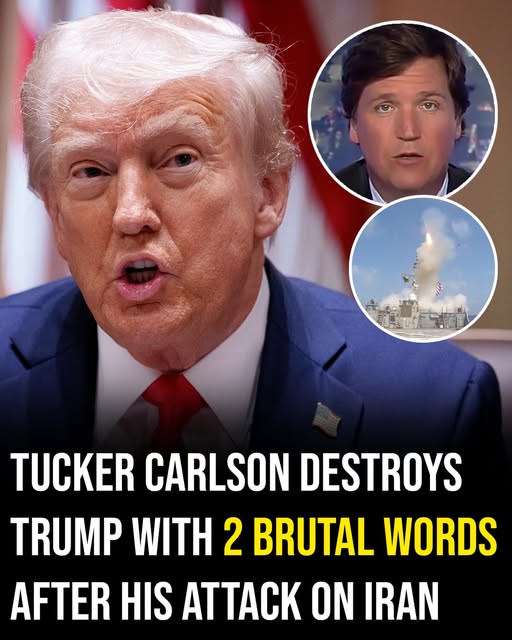
The outrage was immediate and electric. In the night sky above Tehran, missiles streaked like fiery warnings, signaling that America was once again at war. But this time, the circumstances were different — and the reactions more volatile. The attack came under the orders of a Republican president, and instead of rallying a unified front, the nation’s conservative voices erupted in fury. Television screens and social media feeds exploded with condemnation: Tucker Carlson called it “evil,” Rand Paul denounced it as unconstitutional, and Donald Trump himself celebrated, claiming, “48 leaders are gone in one shot.” Yet, the celebration was fractured. The right-wing coalition that had once rallied around Trump was now tearing itself apart, exposing tensions that had long simmered beneath the surface.
The strikes on Iran revealed a raw and bitter fault line within the conservative movement, one that runs deeper than mere policy disagreements. For years, Trump’s most devoted defenders had painted him as the leader who would end “forever wars,” the president who would resist the endless cycle of American intervention overseas. And now, here he was, boasting of having decapitated Iran’s leadership, promising to press forward “until all of our objectives are achieved.” For many of those same loyalists, the sense of betrayal was sharp and personal. Figures like Carlson, Marjorie Taylor Greene, Rand Paul, and Bill Walsh — far from fringe voices — are now the emotional core of the populist right, openly accusing Trump of committing the very acts he once castigated.
But this is not just a story about policy or strategy. The debate cuts deeper, into the very essence of American power, trust, and blood. How many young Americans, they ask, must die for a mission justified in the name of “freedom,” aimed at people who never requested U.S. intervention? How many more families must be shattered, how many more communities scarred, before the cost of war becomes too heavy to bear? Trump warns of the dangers of a nuclear-armed Iran; his critics warn of yet another generation sent to fight a war they neither chose nor wanted.
In this conflict, the conservative movement — once thought to move as one, in lockstep — now confronts a mirror. It sees itself divided, wrestling with its own identity, asking uncomfortable questions: Who are we? What do we truly stand for? And how far are we willing to go when the promises of leadership collide with the realities of war? What was once a unified chorus of loyalty now echoes with uncertainty, anger, and disillusionment, a movement fractured in real time by the very man who once embodied its hopes.