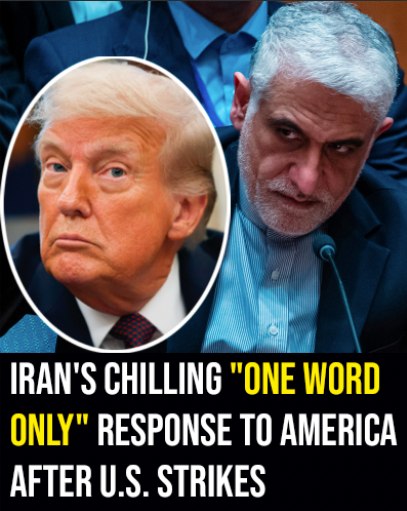
Iran’s chilling “one word only” response to America after U.S. strikes
The world did not wake gently. It jolted awake. Sirens pierced the dawn over Tehran. Columns of smoke climbed into a bruised sky. In Jerusalem, officials huddled in underground rooms, waiting for the next alert. In Washington, D.C., the language from podiums and press rooms was no longer cautious or coded—it was daring, defiant, and edged with threat.
What had simmered for months as stalled nuclear negotiations suddenly detonated into something far more dangerous. A coordinated U.S.–Israeli strike targeting Iran’s leadership shattered decades of unspoken rules. Lines that had been tested but never fully crossed were obliterated in a single night. For Tehran, it was not just an attack—it was a humiliation, a violation of what officials described as their ultimate red line.
And then came the response.
Not a paragraph. Not a speech. Not a list of demands.
One word.
A word delivered with a stillness more unnerving than any shouted threat. A word that signaled resolve, retaliation, and the promise of escalation. A word that seemed to say: this is not the end—this is the beginning.
Within hours, the skies over the region were no longer empty. Waves of missiles and drones surged outward from Iran, arcing toward Israeli territory and toward American military installations across the Middle East. Iranian commanders vowed what they called the “most devastating offensive operation” in the nation’s history. Their message was blunt: the strike on Tehran would not go unanswered, and the cost would not be symbolic.
Israel braced. Missile defense systems roared to life. Air raid sirens wailed. Civilians sheltered as interceptors streaked upward in flashes of white light. The United States warned that any further aggression would be met with force “never seen before,” language so absolute it seemed to close the door on restraint. Words like obliteration, annihilation, and war crimes began to dominate headlines and diplomatic cables alike.
Inside the chamber of the United Nations, the last fragile threads of diplomacy strained to hold. Iran’s ambassador condemned the strikes as a crime against humanity and invoked Article 51 of the UN Charter—the right to self-defense. He accused Washington and Jerusalem of aggression, then delivered a pointed admonition to the United States: “Be polite.” It was a phrase that sounded almost restrained, yet carried the weight of a warning.
Across the aisle, the U.S. envoy refused to yield an inch. Iran’s regime, he said, was murderous and illegitimate. America would not be intimidated. Allies shifted uneasily in their seats. The Secretary-General urged de-escalation, insisting that peace remained the only viable path forward. But even as he spoke, reports confirmed more launches, more impacts, more lives in peril.
This is no longer a shadow conflict waged through proxies and deniable strikes. It is overt, direct, and dangerously personal. Leaders are dead. Military commanders are calculating next moves in real time. Each side insists it does not seek war—while preparing unmistakably for one.
And hovering over it all is that single, chilling word from Tehran. A word that condensed fury, pride, and resolve into a stark declaration. A word that suggested diplomacy has been replaced by destiny.
The world watches, breath held, as history tilts toward an uncertain edge.