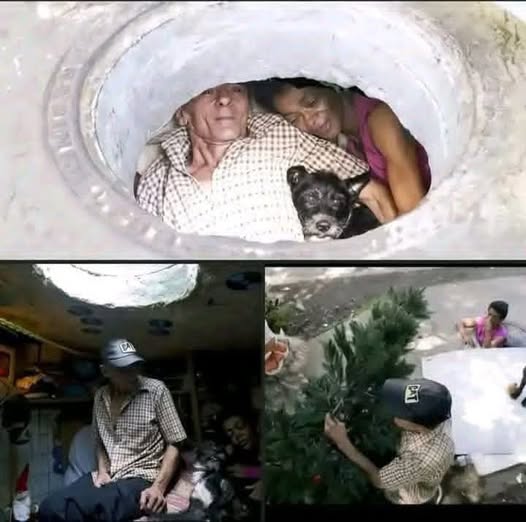
In a world where safe, affordable, and stable housing continues to slip beyond the reach of millions, survival often demands heartbreaking creativity. When rent rises faster than wages and support systems fall short, people are left to search for refuge wherever they can find it. For one couple and their loyal dog, “home” has become the hollow interior of a massive concrete drainage pipe — a structure engineered to move stormwater, now repurposed to shield human life. It is not a place chosen out of preference, but one claimed out of necessity.
From the outside, the pipe appears cold and industrial, indistinguishable from the countless pieces of construction material scattered across development sites. It blends into its surroundings — anonymous, functional, overlooked. Yet step inside, and the space tells a very different story. Within the curved concrete walls lies a carefully arranged living area: a mattress positioned to maximize space, folded blankets stacked with intention, a few personal belongings placed neatly along the edges. Each small detail reflects effort. Each object speaks of dignity. In a space never meant for comfort, they have created a fragile but meaningful sense of order.
The rounded walls offer minimal insulation against the world beyond them. Wind can whistle through the opening. Rainwater threatens during storms. Noise from passing vehicles or nearby activity echoes harshly against the concrete. Privacy is scarce, and the sense of permanence is nonexistent. Yet even limited shelter can mean the difference between exposure and survival. The pipe provides a boundary — however thin — between them and the elements. It offers a place to rest, to gather their thoughts, to exist without constantly moving.
Adding quiet warmth to this stark setting is their dog. In moments of instability and uncertainty, companionship becomes more than comfort — it becomes grounding. A pet provides routine in days that might otherwise blur together. Feeding, walking, caring — these small acts restore purpose and rhythm. The dog’s presence transforms the space from a hiding place into something closer to a home. Loyalty and affection flourish even in confinement, reminding us that connection does not depend on square footage. In hardship, the bond between humans and animals can offer emotional shelter just as vital as physical protection.
Still, the challenges of living in such a space are relentless. Access to clean water and sanitation is uncertain. Extreme temperatures turn the concrete shell into an oven in summer and a freezer in winter. Flooding poses real danger. Safety is never guaranteed. Every day requires vigilance, adaptability, and resilience. What for others is temporary infrastructure becomes, for them, a constant negotiation with risk.
Yet this image is not solely about deprivation — it is also about determination. The careful arrangement of belongings, the effort to maintain cleanliness, the continued care for a pet — these are acts of quiet defiance against despair. They demonstrate a refusal to surrender identity or humanity despite circumstances. Even in the most improvised shelters, people strive to create familiarity, stability, and moments of normalcy.
The drainage pipe stands as a powerful symbol of a larger reality: housing insecurity is not an abstract statistic but a lived experience. Behind every makeshift dwelling is a story of economic strain, unexpected setbacks, limited opportunity, or systemic gaps. Housing is more than walls and a roof. It is safety. It is dignity. It is the foundation upon which health, employment, education, and community are built.
Scenes like this call for more than sympathy — they call for empathy and action. Addressing homelessness and housing instability requires coordinated community effort, thoughtful policy, and long-term investment in affordable housing and support services. Most importantly, it requires recognizing the humanity of those whose lives unfold in spaces never designed to hold them.
Because even within a concrete pipe, where the world might see only infrastructure, there are people creating warmth, protecting love, and holding on to hope.