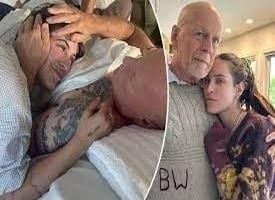
Whispers of tragedy move fast — faster than clarity, faster than compassion. Social feeds ignite within minutes, headlines sharpen into certainty, and suddenly timelines are crowded with urgent claims: that Bruce Willis is in critical condition, hospitalized, fading. The tone is breathless. The posts are shared before they are read. Fear, after all, travels far quicker than facts. And once panic takes hold, almost no one pauses to ask the simplest, most necessary question: Is this even true?
In the digital age, emotion outruns evidence. A single unverified post multiplies into thousands. Concern turns into assumption; assumption hardens into narrative. In the rush to share, to react, to publicly grieve, something deeply human gets lost — patience. We forget that behind the trending topic is a real family, real loved ones, and a real person whose life cannot be reduced to a viral headline.
Rumors about Bruce Willis’s health strike a particularly tender nerve. For decades, he has not just been an actor on a screen but a presence woven into our collective memory. He was the defiant resilience of John McClane in Die Hard, the reluctant hero who limped through danger with grit and wit. He was the haunting quiet at the heart of The Sixth Sense, delivering vulnerability with unforgettable restraint. Through action, drama, and moments of unexpected tenderness, he became part of our cinematic language — a figure who felt familiar, almost personal.
That is why the rumors resonate so powerfully. They tap into a shared fear: the eventual loss of someone who has lived, quietly and steadily, in our imaginations for years. When a beloved figure faces health challenges, it reminds us of fragility — theirs and our own. But as dramatic claims continue to race across screens, it is crucial to note that his family has not issued any new official statement confirming the dire reports now circulating.
And in that absence of confirmation, there is an opportunity — a choice. The most honorable response is restraint. Choosing not to amplify unverified headlines is not indifference; it is respect. It is acknowledging that not every whisper deserves a megaphone. It is recognizing that dignity matters more than clicks.
Bruce Willis has already given the world more than enough. He has left behind performances that shaped an era, characters that endure, and moments of storytelling that will outlive any rumor. Now, the focus should not be on speculation or sensationalism, but on humanity. Illness — whatever its nature — is not public property. It is not a spectacle.
Let the next chapter of his life be written by those who truly know him, those who stand beside him not as fans but as family. Let updates come from voices that carry authority and love, not algorithms chasing urgency. Sometimes the bravest act in a culture addicted to immediacy is to pause. To wait. To care quietly.
Because at the end of the day, the story is not about breaking news. It is about a human being. And sometimes, the greatest tribute we can offer is patience.