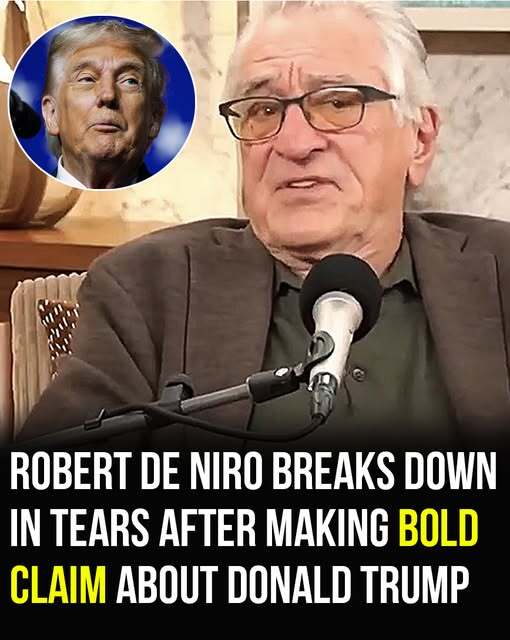
For years, Robert De Niro has never been shy about his disdain for Donald Trump. His words were sharp, his tone unflinching, his message unmistakable. But this time was different. This time, he didn’t just speak out—he unraveled.
Appearing on Nicolle Wallace’s podcast, the legendary actor set aside the steel-edged defiance the public has grown accustomed to. What emerged instead was something far more vulnerable. His voice trembled. His hands shook slightly as he tried to steady himself. The decades-long war of words that once felt theatrical and combative suddenly gave way to something painfully human. When the conversation turned to unity, to fate, to the uncertain future of America, his composure cracked—and with it, the myth of the untouchable icon.
For years, De Niro’s criticism of Trump carried the tone of resistance. In this interview, it carried the weight of grief. Seated across from Wallace, he seemed less like a towering figure of cinema and more like an aging citizen grappling with fear for his country’s soul. He spoke about democratic institutions he believes are eroding under pressure. He described a nation where neighbors eye each other with suspicion, where political identity can fracture families, and where outrage often drowns out empathy. His concern wasn’t abstract or rhetorical; it felt personal, almost paternal—as though he were mourning a version of America he once trusted.
When Wallace commended him for using his platform to uplift rather than degrade, the praise didn’t embolden him. It undid him. The compliment pierced through his armor, and for a moment, the man known for portraying hardened characters revealed a fragility rarely seen in public. His tears weren’t about Hollywood accolades or public perception. They were about helplessness—the gnawing fear that division has calcified into something permanent, that cruelty has become currency, that truth itself feels negotiable.
What made the exchange resonate beyond partisan boundaries was not the politics, but the humanity. De Niro did not present himself as a savior. He didn’t offer grand solutions or dramatic ultimatums. Instead, he pleaded—quietly but urgently—for engagement. For participation. For ordinary citizens to show up, to speak up, to refuse the normalization of hatred and indifference. He warned that the forces unleashed in recent years will not simply vanish with a single election cycle or the exit of one leader. Left unchallenged, they could linger, reshape norms, and redefine what the nation tolerates.
Yet even in his most emotional moments, there was a flicker of stubborn hope. Beneath the exhaustion and fear, he clung to a belief that Americans still have agency—that they can still choose compassion over chaos, accountability over apathy, unity over tribalism. His breakdown was not spectacle. It was not a celebrity’s dramatic flourish. It was a mirror reflecting what many feel but rarely voice: a deep weariness with endless conflict, a quiet terror about the future, and an equally quiet refusal to abandon the dream of a country worth fighting for—together.