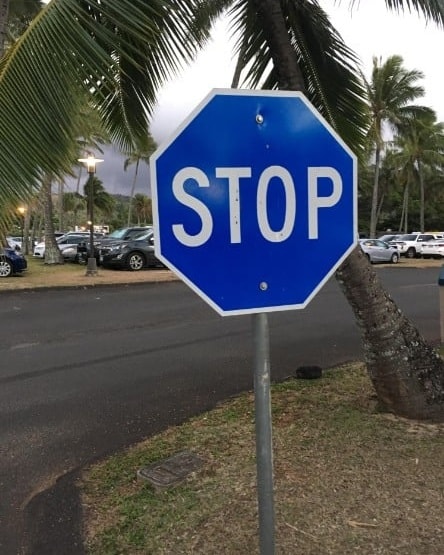
People studying for their drivers licenses may be confused when they come across a blue stop sign. But the fact is, most people are when they see them in the United States and other countries. Stop signs have become practically synonymous with red. After all, the color is bright, hard to miss, and perfectly suited to stop traffic. But it’s not always utilized. You may come across a stop sign that’s a strangely serene blue, and wonder how to react.
What is the meaning of a blue stop sign?

When you see a blue stop sign, you make a full stop. In a nutshell, the purpose of a blue stop sign is the same as the red one. However, there is a difference in who is ordering the halt. Blue stop signs aren’t placed by the U.S. Department of Transportation. Rather, they were put up by a private citizen, and they are most commonly found in Hawaii compared to any other state.
“The short answer to the question about blue stop signs is that in the U.S., the shape and colors of signs (including stop signs) are identified in a document known as the Manual on Uniform Control of Traffic Devices,” says Shashi Nambisan, PhD, director of the Transportation Research Center at the University of Nevada, to Reader’s Digest. “To the best of my knowledge, blue-colored stop signs are not permitted on public roads. However, it is possible that they may have been installed on private property.”
For example, a property owner may pay out of pocket to place a stop sign on their land. Then it can indicate drivers to stop as they drive through a large estate, ranch, private golf course, etc. Hawaii has more blue stop signs than other states because of laws that prohibit official government-issued signs on private property. Like all traffic signs, they are used to enforce road safety.