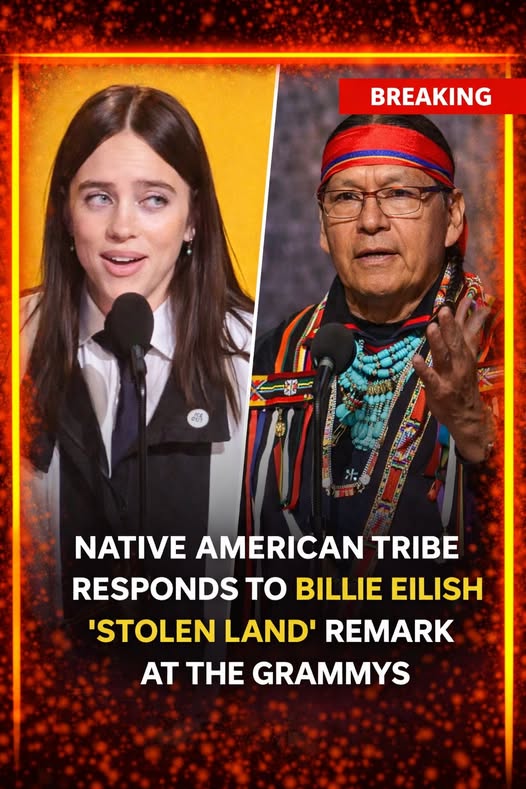
Billie Eilish’s standing ovation at the Grammys felt like a full stop. It wasn’t.
When the pop star declared “no one is illegal on stolen land” from the Grammy stage, the Crypto.com Arena erupted. The moment was instantly canonized online: bold, brave, uncompromising. Applause thundered. Clips went viral. A culture-war backlash flared just as quickly—one she never addressed by name.
But far from the arena lights and cable-news outrage, the words landed somewhere quieter and far more consequential: with the people whose land she had invoked.
The Tongva Nation—the First People of the Los Angeles Basin—had been listening.
For generations, the Tongva have lived with a peculiar kind of erasure. Their land hosts Hollywood premieres, global award shows, and the homes of some of the world’s most powerful celebrities, yet their name is rarely spoken. So when Eilish referenced “stolen land,” it cut through the noise—not as a slogan, but as a direct echo of their lived reality.
Their response, issued days later, was neither hostile nor starstruck. It was measured. Gracious. And unmistakably pointed.
Yes, they said, they appreciated the visibility. Any public acknowledgment of Indigenous history—especially on a stage as massive as the Grammys—matters. But they also clarified what applause alone cannot fix: Billie Eilish lives on Tongva ancestral land, and despite invoking their history on the world’s biggest music stage, she has never reached out to them directly.
That silence, they suggested, is where symbolism starts to fray.
As political figures mocked the speech and critics demanded celebrities “give back their mansions,” the Tongva refused the spectacle. They weren’t asking for her house. They weren’t interested in performative punishment. Instead, they asked for something both simpler and far more challenging: recognition that goes beyond a line in a speech.
Say our name, they urged. Build real relationships. Acknowledge us not as an abstract idea, but as a living people.
Their statement cut cleanly through the culture-war chaos. While pundits argued over whether Eilish had gone “too far,” the Tongva redirected the conversation toward the future—one where Indigenous nations are not footnotes in progressive rhetoric, but active participants in shaping cultural institutions. They pointed to their work with the Recording Academy on land acknowledgments as an example of what meaningful partnership can look like.
And then they closed with a declaration that needed no amplification, no viral clip, no standing ovation.
“Ekwa Shem,” they wrote.
We are here.