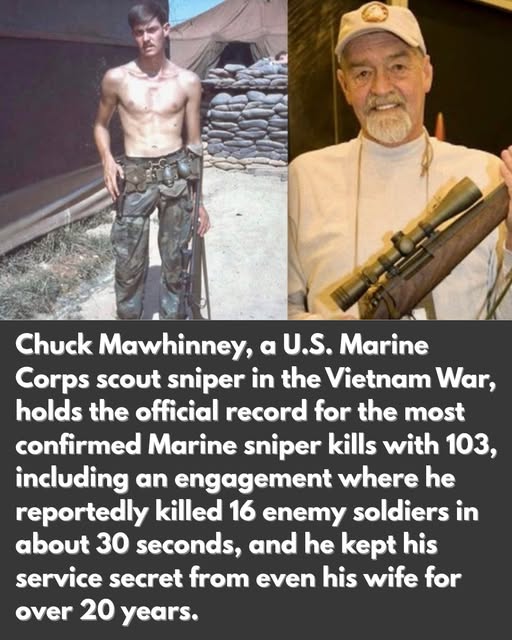
Mothers never spoke his name, and children never learned it. But deep in the jungles of Vietnam, enemies whispered it with fear. From the quiet forests of Oregon came a soft-spoken Marine who would become the deadliest sniper in American history—and then, just as quietly, disappear back into ordinary life. There were no victory parades waiting for him. No headlines chasing his return. For decades, even the people closest to him had no idea who he truly was.
Chuck Mawhinney was barely out of boyhood when the Marine Corps taught him a skill built on patience, precision, and emotional restraint: how to lie perfectly still, how to watch without being seen, and how to pull a trigger only when failure was not an option. Between 1968 and 1969, he blended into the mud, rain, and shadows of Vietnam, sometimes remaining motionless for hours—or days—until a single moment demanded absolute focus. The official tally credited him with 103 confirmed kills and 216 probables, numbers so stark they feel unreal, placing him above even legendary figures like Carlos Hathcock. In one harrowing episode in February 1969, he reportedly eliminated sixteen enemy soldiers in less than thirty seconds—a flash of violence so intense it would ripple through Marine Corps lore long after the jungle fell silent.
And yet, when the war ended, Mawhinney refused to let it define him publicly. He returned home and chose anonymity over acclaim, trading the rifle for routine, burying extraordinary deeds beneath the weight of normal life. For more than twenty years, he spoke little of Vietnam, never boasting, never seeking recognition, carrying his memories alone. It was only when another Marine referenced his name in a book that the truth emerged and historians began to piece together what he had accomplished. Honors eventually followed, including the Navy Cross—but even then, he remained reserved, almost uncomfortable with the attention.
Today, Chuck Mawhinney is recognized as the most successful sniper in Marine Corps history, not as a symbol of triumph, but as something far more complex. His story is a reminder that some of the most consequential chapters of war are written in silence—and that long after battles are officially over, their echoes live on in the minds of those who survived them.