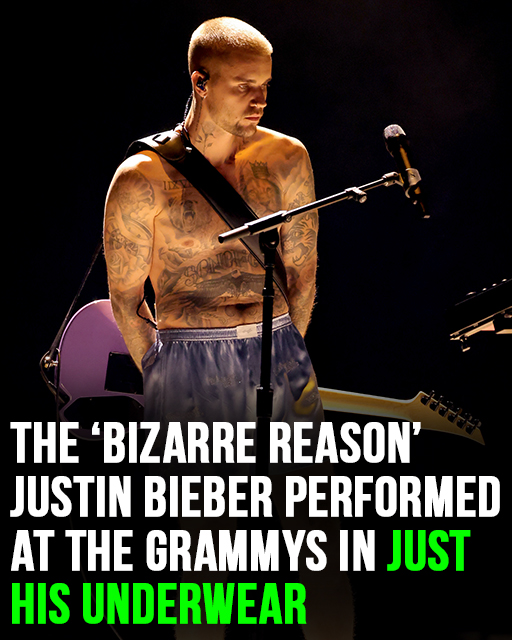
Justin Bieber didn’t walk onto the Grammy stage so much as he detonated it. Dressed in nothing but boxer shorts and clutching a purple guitar, he froze the room in collective disbelief. For a split second, no one knew how to react. Was this a breakdown? A prank? A reckless dare taken too far? The silence felt heavy, almost uncomfortable—until the internet did what it always does. Social media erupted instantly. Memes flooded timelines. Think pieces formed in real time. Mockery, confusion, and fascination collided in a chaotic digital storm.
But beneath the noise, something far more calculated was unfolding.
What looked like a wardrobe malfunction—or a career-threatening lapse in judgment—was, in fact, a precision strike. By stepping on one of the world’s most watched stages wearing boxers from his own Skylrk brand, Bieber transformed the Grammys into a global catwalk. Screenshots traveled faster than official press releases. Every joke, every sarcastic tweet, every outraged comment became unpaid promotion. Even his harshest critics played a role, amplifying the image and spreading the message without realizing it. Vulnerability became currency. Exposure became leverage.
The brilliance of the stunt lay in its contradiction. Bieber appeared almost naked—exposed, fragile, human—yet he was completely in control. The line between authenticity and strategy blurred so seamlessly that people couldn’t tell where one ended and the other began. Was he baring himself emotionally, or was he reminding the world that attention, even negative attention, is power when you know how to wield it?
And then there was the deeper layer—the one that couldn’t be memed away.
After canceling his 2022 tour due to serious health concerns, doubts followed him everywhere. Fans wondered if the pop icon who once dominated every chart could ever truly return. Critics whispered about decline, burnout, irrelevance. That Grammy appearance, stripped of armor and spectacle, felt like an answer. The performance wasn’t polished perfection; it was raw, risky, and unapologetic. It suggested an artist no longer chasing approval, but reclaiming authorship over his own narrative.
Love it or hate it, the moment landed with force. It made people talk. It made people argue. And most importantly, it made people look. Justin Bieber wasn’t fading quietly into nostalgia—he was rewriting the rules of visibility, fame, and control, on his own terms, with the entire world watching.