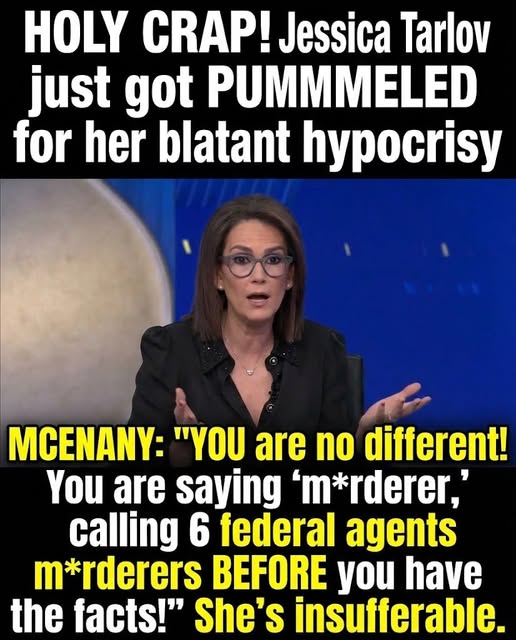
The studio went quiet for a moment, an almost eerie calm before the storm. Then the tension exploded. Kayleigh McEnany had reached her breaking point. On live television, during a heated discussion over federal agents’ actions, Jessica Tarlov casually dropped the word “murderer.” The air seemed to crack with it. McEnany didn’t just respond—she erupted, her voice sharp, precise, and unforgiving. Millions of viewers across the nation watched the confrontation unfold in real time, the intensity almost palpable through their screens. What followed was not just a clash of opinions; it was a collision of values, principles, and perceptions that reverberated far beyond the studio walls.
McEnany’s response was swift and unflinching. Her accusation was simple, yet devastating: labeling federal agents as “murderers” without all the facts wasn’t just rhetoric—it was recklessness. Her words cut deeper because they weren’t aimed solely at Tarlov; they challenged a broader culture of instant outrage, where social media and 24-hour news cycles have turned snap judgments into a daily ritual. In that tense exchange, McEnany held up a mirror to America’s political media landscape, reflecting just how fragile, polarized, and combustible it has become.
The clip didn’t just make headlines—it ignited a debate. To some, McEnany’s rebuttal was a long-overdue pushback against dangerous language, a reminder that words have weight and that public trust in institutions can’t be casually discarded. To others, Tarlov’s words were a legitimate expression of frustration and accountability, a challenge to authority that journalism is meant to encourage. The debate was instantaneous, spreading across social media with lightning speed, as pundits, viewers, and commentators dissected every inflection, every gesture, every syllable.
What’s undeniable is the moment’s symbolism. In today’s media climate, a single exchange—mere seconds of live television—can become a flashpoint, a viral Rorschach test revealing deep divides in perception and ideology. Every panel discussion is a battlefield, every comment a potential spark, and every heated confrontation a reflection of the stakes involved in shaping public discourse. In this case, McEnany’s stand wasn’t just about a word; it was about the power of language, the responsibilities of the media, and the tensions that define an America on edge, watching, judging, and reacting in real time.