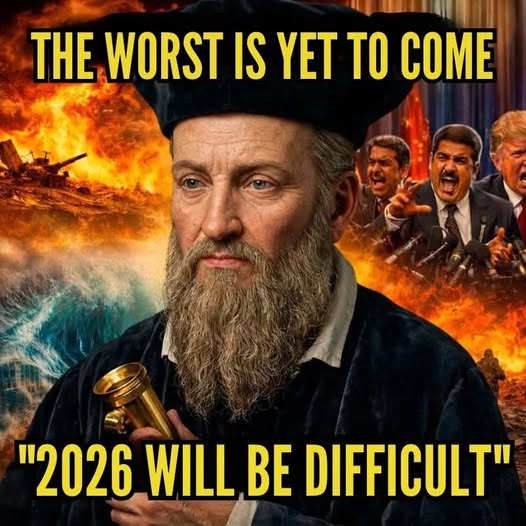
The year 2026 is not just another number waiting to be crossed off a calendar. To some interpreters of Nostradamus, it is the moment when the world doesn’t explode in a single, dramatic end—but fractures all at once. Not one apocalypse, but many. A slow cascade of crises unfolding in different places, in different forms, all feeding into one another.
These are not wars fought with marching armies or mushroom clouds. They are silent wars, waged through invisible systems—lines of code, supply chains, digital networks that hum quietly beneath modern life. When those systems fail, there are no gunshots, only confusion, shortages, and the sudden realization that trust itself has collapsed. Power grids flicker. Markets freeze. Information becomes unreliable, and fear spreads faster than truth ever could.
Above us, the skies grow hostile. Air once taken for granted turns fields barren, poisoning crops and turning farming into a dangerous gamble. Climate pushed beyond its limits stops behaving predictably. Droughts linger where rain once fell. Storms arrive where calm once lived. Entire regions become uninhabitable, forcing millions to move—not by choice, but by necessity. Governments are cornered into impossible decisions: Who gets shelter? Who gets turned away? How do you choose between compassion and survival?
At the edges of the continents, the seas continue their quiet advance. No negotiations. No mercy. Rising waters erase coastlines, swallow neighborhoods, and rewrite maps that once felt permanent. Homes vanish. Histories dissolve. Economies crumble. What was once solid ground becomes a memory, exposing how temporary our sense of stability has always been.
And then there is disease—not a dramatic plague that strikes at humanity’s peak, but a sickness that arrives when we are already exhausted. When hospitals are stretched thin, institutions are brittle, and public trust is fragile. It doesn’t just test our immune systems; it tests our capacity to cooperate. It reveals how narrow our margin of safety truly is, and how unprepared we are when multiple crises collide at once.
For those who study Nostradamus, 2026 is not a fixed doomsday etched in stone. It is something far more unsettling: a stress test of everything modern civilization relies upon. A warning about what happens when complex systems are stretched too far, when efficiency replaces resilience, and when we mistake convenience for strength.
Yet hidden beneath the fear is another message—one often ignored. These visions are not commands, and they are not destiny. They are cautions. A question posed across centuries, aimed directly at us:
Will we continue to live on fragile systems and wishful thinking, hoping nothing breaks? Or will we acknowledge our vulnerability and act while we still can?
In this reading, preparation is not panic—it is hope. Cooperation is not weakness—it is survival. And solidarity, not prophecy, becomes the only future worth believing in.