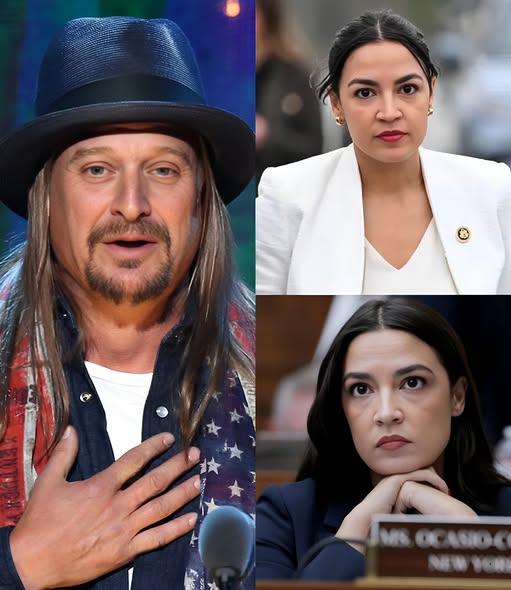
The studio seemed to seize up the instant the words left her mouth. Lights still blazed, cameras still hummed, but everything else felt suspended—like the air itself had been cut and was waiting to see what would spill out next. One sentence, sharp and unyielding, echoed across the set and into millions of homes: “Your time is over.” Alexandria Ocasio-Cortez didn’t raise her voice. She didn’t need to. The weight of the moment carried it for her. Across from her, Kid Rock stood still, absorbing the declaration as the nation collectively leaned closer to their screens.
This was supposed to be a collision—generational, cultural, ideological. A symbol of the new America confronting the old. Viewers braced for a retort fueled by anger or bravado, a defense of relevance, fame, or defiance. Instead, what came next landed with a different kind of force. When Kid Rock finally spoke, his reply didn’t roar. It didn’t posture. It cut quietly, almost tenderly, through the noise everyone had expected.
He didn’t argue about his career or his influence. He didn’t spar over politics or trade insults. Instead, he admitted something far more vulnerable: a fear that the country was losing its ability to listen at all. In that moment, the confrontation shifted. What had looked like a symbolic execution of the past transformed into an unexpected confession about the future. His words reframed the exchange—not as a winner-takes-all showdown, but as a warning about what happens when dialogue dies.
Suddenly, the tension in the room wasn’t about whose era was ending. It was about whether America itself was willing to survive its own divisions. His restraint forced a pause, the kind that makes people uncomfortable because it demands reflection instead of reaction. The silence that followed wasn’t empty; it was heavy with recognition.
Across living rooms, sports bars, and glowing phone screens, people felt themselves pulled into that moment. Some saw their frustration mirrored in AOC’s urgency—the hunger for change, the impatience with systems and voices that feel immovable. Others felt seen in Kid Rock’s response—the exhaustion of being shouted past, the fear of becoming invisible in a country racing forward without looking back. Comment sections erupted not because of outrage alone, but because the exchange struck a nerve too close to ignore.
Together, without intending to, they exposed something raw and unresolved at the heart of the nation. America isn’t just divided by ideology; it’s divided by how it handles disagreement. One side wants to tear down what no longer works. The other fears that in the fire, something essential—empathy, memory, connection—will be lost forever. That brief, frozen moment on camera became a mirror, asking a question no one could dodge: Do we want to win at all costs, or do we still believe understanding is possible?
The studio eventually moved on. The cameras cut. But the silence lingered. And long after the lights dimmed, that exchange continued to echo—not as a viral soundbite, but as a reminder that the most dangerous thing a country can lose isn’t relevance or power. It’s the willingness to hear one another before time truly runs out.