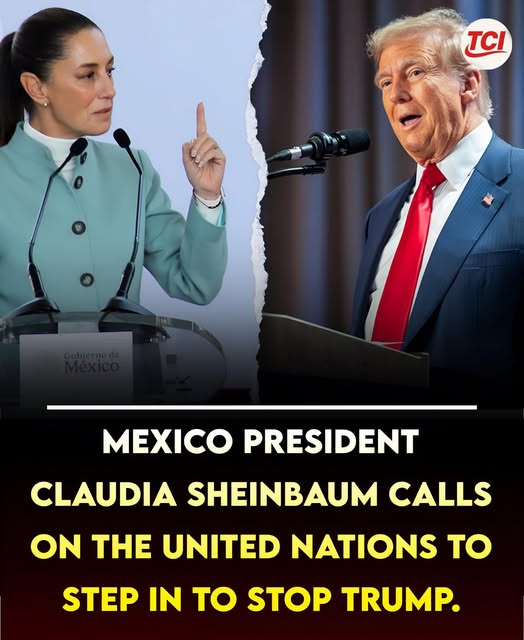
Mexico’s warning landed like a thunderclap — and it wasn’t just noise.
In a rare and unflinching public rebuke of the United States, President Claudia Sheinbaum stepped far beyond diplomatic routine and delivered a stinging critique of Washington’s sudden military operation in Venezuela — one that culminated in the reported capture of President Nicolás Maduro. What might have been a static communiqué instead exploded across international headlines, invoking not only the United Nations Charter and Mexico’s own Estrada Doctrine, but also the deep, historical anxieties of a hemisphere intimately familiar with foreign intervention. Mexico Solidarity Media+1
The United States’ dramatic action — elite forces striking in Caracas, Maduro and his wife being taken into U.S. custody and flown out of the country — has already reshaped regional geopolitics. The raid, which echoed past interventions and carried significant casualties, was justified in Washington as a move against alleged narco-terrorism, but it has been condemned globally as a dangerous precedent that could unravel longstanding norms of sovereignty and non-aggression. The Washington Post+1
In this fraught context, Sheinbaum’s denunciation was nothing less than a redrawing of diplomatic fault lines. She categorized the U.S. operation not as a tactical misstep or policy debate, but as a fundamental breach of international law, one that strikes at the core of how nations — especially those in Latin America — relate to one another. By explicitly grounding her response in Article 2(4) of the UN Charter, which prohibits the threat or use of force against the territorial integrity or political independence of any state, and by invoking Mexico’s historic Estrada Doctrine of non-intervention, she made clear that Mexico sees this moment as far bigger than the politics of Caracas. Mexico Solidarity Media
Sheinbaum’s choice of language was both legal and symbolic: this was not a critique born of ideological affinity with Venezuela’s government, but a defense of a principle that undergirds modern diplomacy. It was a reminder that sovereignty isn’t just a high-flown idea in textbooks — it’s the bedrock of national dignity, regional stability, and trust between neighbors. Mexico Solidarity Media
The resonance was swift.
Leaders across Latin America — from Brazil to Argentina and beyond — registered alarm, caution, or outright condemnation. For many, memories of coups, covert operations, and external meddling are not distant history but living memory. In countries where ordinary citizens once watched foreign military boots land on distant shores, the question today is chillingly immediate: who decides the fate of a nation — its people, or another power’s armed forces? Axios
Sheinbaum didn’t stop at legal rhetoric. Her broader appeal urged a return to multilateralism, insisting that Venezuela’s future must be forged through diplomacy, negotiation, and respect for the will of its people — not the roar of jets and the shadow of armed commandos. The message was sent not only to Caracas and Washington, but to the world: dialogue, not force, should determine the destiny of nations. Mexico Solidarity Media
She also explicitly reminded Washington that cooperation on migration, security, trade, and shared threats cannot be taken for granted. Mexico, she signaled, will continue to work with the United States where their interests align — but not at the expense of its sovereignty or fundamental legal principles. In choosing law over loyalty and principles over pressure, Mexico underscored that the real struggle isn’t only about Caracas — it’s about the rules that will govern power and restraint in the Americas going forward. Mexico Solidarity Media
That warning — delivered with historical gravitas and geopolitical precision — has now entered the broader debate over how great powers engage with smaller states, how regional solidarity functions in a fractious age, and whether diplomacy still has a place in an era of rapid shocks and unilateral force.
In a hemisphere scarred by past interventions, the question now is stark: will diplomacy hold, or will this moment become the first step toward a more coercive era in the Western Hemisphere?