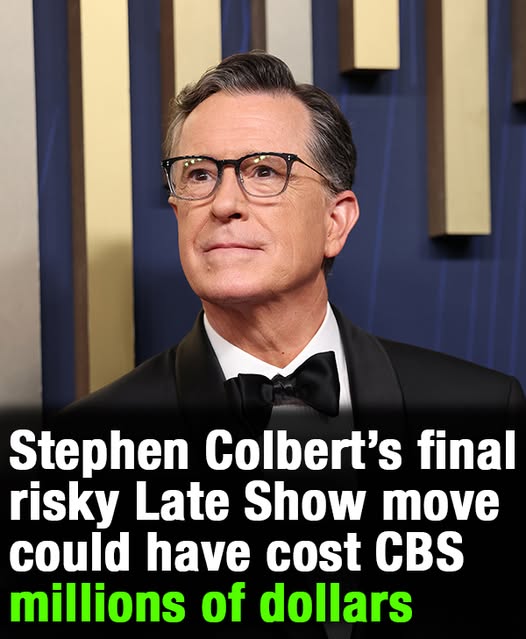
Stephen Colbert didn’t leave late-night television with a quiet goodbye or a carefully polished farewell speech. He left the way he built his career — sharp, fearless, and fully aware of exactly where to land the punch. And in the final moments of The Late Show, surrounded by celebrities, comedy legends, and an audience hanging on every word, Colbert delivered one last jab that instantly became the most talked-about moment of the night.
It lasted barely seven seconds.
The band suddenly slipped into the unmistakable Peanuts theme — playful, innocent, almost absurdly cheerful. Colbert paused, stared directly into the camera, and with perfect timing dropped a line that sliced through months of corporate damage control like a blade:
“Oh no, I hope this doesn’t cost CBS any money.”
The audience exploded. But the real impact wasn’t just the laugh. It was the meaning behind it.
For months, CBS executives had insisted the turmoil surrounding Colbert’s future had “nothing to do with content,” blaming financial pressures, restructuring, and shifting priorities. Yet viewers never fully bought the explanation. Not after the network reportedly spent millions trying to bury controversy tied to Donald Trump. Not after Colbert openly mocked the decision on-air and labeled it what many critics were already whispering — “a big fat bribe.”
That final joke suddenly felt less like comedy and more like a public reckoning.
You could see it on Colbert’s face. The smile was there, but underneath it sat something heavier: defiance, frustration, and the satisfaction of finally saying what contracts, executives, and polished press releases never allow people to say out loud. In one perfectly timed sentence, he exposed the tension between corporate power and creative freedom — and he did it while making millions laugh.
The brilliance of the moment was how effortless it looked. No angry rant. No dramatic monologue. No bitter farewell. Just a tiny crack delivered with surgical precision. The kind of joke only works when the audience already knows the story behind it. And they did.
Social media lit up instantly. Clips spread within minutes. Fans called it legendary, savage, and the perfect ending to an era. Because what Colbert managed to do in those final seconds was bigger than defending himself. He reminded viewers why they trusted him in the first place. He was willing to say the uncomfortable thing. Willing to mock the powerful. Willing to risk consequences for the sake of honesty wrapped in humor.
That brief Peanuts melody became symbolic — a mischievous final wink before the curtain closed. A reminder that comedy, at its best, doesn’t just entertain. It exposes. It provokes. It leaves scars under the laughter.
CBS may still own the studio, the cameras, the logo, and the coveted late-night time slot. But in the end, Colbert walked away with something far more valuable: the audience’s loyalty, the moral victory, and the final word.
And judging by the roar inside that theater, everyone knew exactly who won.