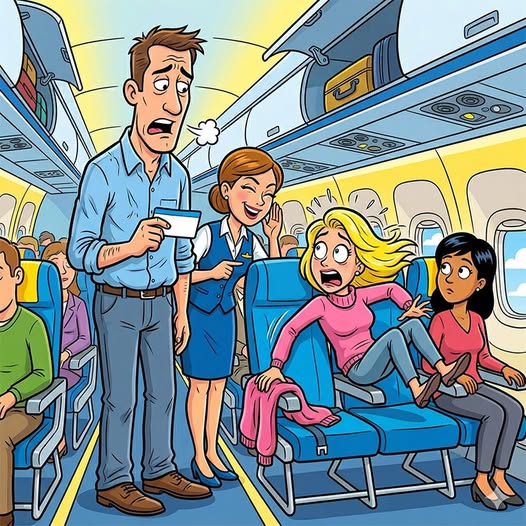
At 30,000 feet above the clouds, what should have been an ordinary flight to New York slowly transformed into a tense and unforgettable spectacle that no passenger in row 17 would ever forget.
It began with a simple request.
Mr. Johnson, a tall businessman with broad shoulders and legs far too long for the cramped economy cabin, stood awkwardly beside his assigned middle seat while passengers shuffled luggage into overhead bins. The woman seated beside him—a blonde in a perfectly pressed white jacket—had stretched herself comfortably across the aisle seat, headphones on, expression cold and immovable. The tiny middle seat waiting for him looked more like punishment than transportation.
With a polite smile, Mr. Johnson leaned closer.
“Excuse me,” he said gently. “Would you mind switching with me? I’d really appreciate the aisle seat. I’m a bit too tall for the middle.”
The blonde barely glanced at him.
“No.”
The answer was immediate. Sharp. Final.
A few nearby passengers lifted their eyes from their phones. Mr. Johnson forced an embarrassed laugh, assuming she must not have understood.
“I can trade seats with you,” he continued carefully. “You’d still have a comfortable spot, and it would help me a lot during the flight.”
Again, she shook her head.
“I chose this seat because I wanted space. I’m not moving.”
The tension thickened instantly.
Passengers nearby pretended not to listen while clearly listening to every word. A mother across the aisle paused mid-sentence with her child. A college student removed one earbud. Even the man in front subtly lowered his newspaper to watch the unfolding drama.
Mr. Johnson tried once more, this time almost pleading.
“It’s a long flight. I’ll barely fit in the middle seat.”
But the blonde folded her arms and stared straight ahead, her expression carved from stone.
“No.”
Now the silence around them became heavier than the engines roaring outside.
Mr. Johnson sighed and squeezed awkwardly into the narrow middle seat, shoulders pressed tightly between strangers, knees jammed painfully against the tray table ahead. Every movement seemed to irritate the blonde further, and every uncomfortable adjustment drew more curious glances from nearby passengers.
What started as a minor inconvenience had quietly turned into a humiliating standoff.
Minutes later, a flight attendant approached, her calm smile hiding the fact that she had clearly noticed the growing discomfort spreading through the cabin.
“Is there a problem here?” she asked softly.
Mr. Johnson explained the situation with visible embarrassment, trying not to sound angry or entitled. The blonde interrupted twice to insist she was sitting exactly where her ticket allowed.
The flight attendant listened patiently.
Then she leaned down toward the blonde and whispered five quiet words.
No one else heard them.
But the effect was immediate.
The blonde’s face changed instantly. Her confidence evaporated. Her eyes widened slightly as if she had suddenly realized something terrible. Without another argument, without even a sigh, she unbuckled her seatbelt, grabbed her handbag, and slid silently into the middle seat.
The entire row seemed to exhale at once.
A few passengers exchanged confused looks. Someone in the back chuckled quietly. Mr. Johnson blinked in disbelief.
Just moments earlier, she had refused every polite request, every compromise, every appeal to basic kindness. Yet one quiet sentence from the flight attendant had shattered her resistance in seconds.
For the rest of the flight, curiosity haunted him.
What had the attendant said?
Was it a rule? A warning? Some hidden airline policy passengers didn’t know about? Had she threatened to remove her from the plane? Was there some authority in her voice that ordinary travelers simply couldn’t access?
Mr. Johnson replayed the moment again and again while the aircraft crossed the night sky toward New York.
The blonde remained unusually quiet for the rest of the journey. No headphones. No attitude. No complaints. She simply stared ahead as though trying to avoid everyone’s eyes.
And that only deepened the mystery.
When the plane finally landed and passengers began collecting bags from the overhead compartments, Mr. Johnson spotted the flight attendant near the exit door.
Unable to resist, he smiled and asked quietly, “Okay… I have to know. What did you say to her?”
The attendant laughed softly, a playful glimmer appearing in her eyes.
“Oh, it was nothing serious,” she replied.
Mr. Johnson waited.
She leaned closer and whispered:
“I told her the aisle seat wasn’t going to New York.”
For a moment, he simply stared at her.
Then realization hit him all at once.
There had been no threat. No airline policy. No disciplinary warning.
Just a perfectly timed psychological trick.
The blonde hadn’t moved because she respected authority—she moved because, for one brief second, panic overpowered pride. The possibility of ending up in the wrong place shattered her certainty instantly. Her stubborn confidence collapsed under the weight of a single absurd idea delivered with enough calm authority to sound believable.
As Mr. Johnson stepped off the plane laughing, he realized the entire bizarre confrontation had become something far more memorable than a fight over legroom.
It was a lesson.
A reminder that human behavior is often far less rational than we pretend. That confidence can vanish in seconds. And that sometimes, the most powerful form of persuasion isn’t force, anger, or argument—
—but a few carefully chosen words spoken at exactly the right moment.