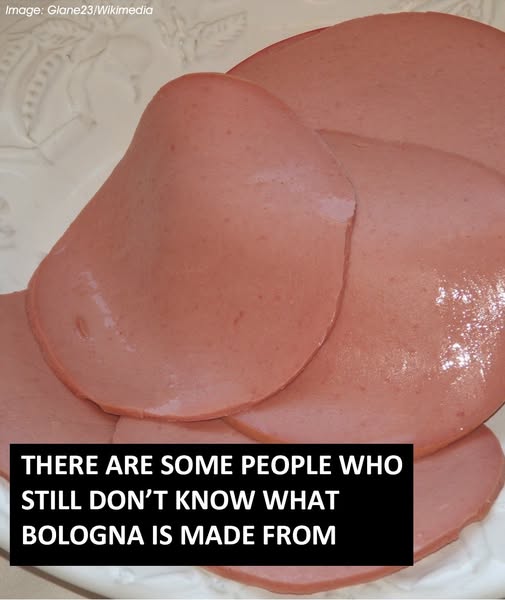
Bologna hides a secret most people never stop to question. It sits quietly in school lunchboxes, layered between slices of cheap white bread, folded into perfect neon-pink circles that somehow look both comforting and suspicious at the same time. Generations have grown up eating it, mocking it, and warning each other about it in the very same breath. It’s the sandwich meat everyone jokes about — the symbol of “processed junk food” — yet supermarket shelves keep emptying because people continue to buy it by the pound.
But what if the truth behind that smooth pink slice is far stranger, more historic, and far more carefully engineered than the myths people whisper about online?
For decades, bologna has carried an almost legendary reputation. People imagine factory floors filled with mystery scraps, unidentifiable leftovers, and horror stories involving beaks, hooves, and whatever else urban legends can invent. It became the punchline of cafeteria jokes and late-night comedy sketches, a food people pretended to hate while secretly craving its salty, smoky comfort. Yet the reality is far less chaotic — and far more fascinating.
Modern bologna is not random “meat mush” tossed together without rules. In fact, it is one of the most tightly regulated descendants of centuries-old sausage-making traditions. Today’s bologna is typically produced from beef, pork, chicken, or a combination of all three. The meat is finely ground and blended with fat, spices, seasonings, and curing agents until it forms a smooth emulsified mixture. That paste is then stuffed into casings — natural or synthetic — before being cooked, smoked, and transformed into the familiar slices people recognize instantly.
That unmistakable texture isn’t accidental. It’s engineered for consistency. Every slice is designed to look, taste, and feel exactly the same, whether it’s opened in a kitchen in New York, Texas, or a tiny rural grocery store somewhere in the Midwest. The smoothness people often mock is actually the result of precise industrial food science combined with old-world sausage techniques refined over centuries.
And that’s where bologna’s hidden history becomes impossible to ignore.
Its true ancestor is not some modern factory invention but the celebrated Italian sausage known as mortadella. Originating in the city of Bologna, Italy, mortadella was once considered a luxurious and carefully crafted delicacy. Unlike American bologna’s uniform pink appearance, traditional mortadella proudly displays cubes of creamy white fat scattered throughout each slice, along with visible peppercorns, spices, and sometimes pistachios. It carries a rich aroma, deep seasoning, and a culinary heritage stretching back hundreds of years.
American bologna evolved from this tradition but took a very different path. Instead of celebrating variation and artisanal texture, it became streamlined for mass production, affordability, and shelf stability. The visible fat disappeared. The texture became perfectly smooth. The flavor softened into something milder, saltier, and more universally approachable. It transformed from an old-world sausage into an industrial-age comfort food built for speed, convenience, and enormous scale.
Yet despite all the jokes, the ingredient list tells a surprisingly ordinary story. Read the label carefully and you’ll usually find exactly what the product is: meat, fat, spices, salt, curing agents, sweeteners, and preservatives. It’s undeniably processed. It’s not health food. But it’s also not the horrifying “mystery meat” monster people love to imagine. Strict food safety regulations and consumer expectations have pushed manufacturers toward standardized ingredients and controlled production methods far removed from the nightmare myths that surround the product.
In many ways, bologna represents something uniquely modern. It’s a food born from contradiction. People criticize it while craving it. Parents pack it for convenience while warning kids about processed foods. Society treats it as cheap and low-class, yet its roots trace directly back to one of Europe’s most respected sausage traditions.
Maybe that’s why bologna has survived for so long. Beneath the jokes and stereotypes, it offers something people secretly value: familiarity. It’s the taste of rushed school mornings, late-night sandwiches, childhood kitchens, gas station snacks, and simple meals that require almost no effort. It’s comfort disguised as controversy.
And perhaps that’s the real secret hiding inside every pink slice. Bologna was never just about what’s in it. It’s about what people project onto it — nostalgia, class, convenience, suspicion, and comfort all wrapped together in one perfectly uniform circle of processed meat the world keeps pretending not to love.