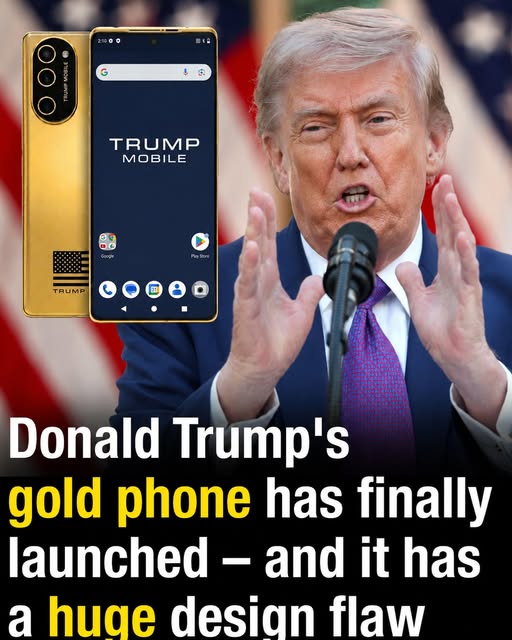
The moment the gold “T1” Trump Mobile finally arrived in customers’ hands, the excitement that had been building for months vanished almost instantly. What was supposed to be a triumphant launch — a bold symbol of patriotism wrapped in gold plating and political branding — quickly turned into a storm of scrutiny across social media. Within hours of the first unboxing photos appearing online, users began zooming in on every tiny detail. And then came the discovery that ignited a firestorm: the American flag displayed on the back of the phone appeared to have only 11 stripes.
That single detail changed the entire conversation overnight.
For many supporters, the T1 wasn’t just another smartphone. It was marketed as a statement — an “all-American” device that promised to stand against overseas manufacturing dominance and represent American pride, strength, and identity. Buyers placed deposits of up to $100, endured repeated shipping delays, and defended the project online for months, believing they were backing something bigger than technology. The arrival of the phone was supposed to feel like vindication. Instead, the missing stripes transformed the launch into a viral controversy that critics seized on immediately.
To some observers, the issue was nothing more than an embarrassing design oversight — a rushed mistake that slipped through quality control. But to others, the symbolism felt impossible to ignore. How could a phone marketed so aggressively around patriotism and “American values” get one of the country’s most recognizable symbols wrong? The backlash wasn’t really about graphic design anymore. It became about credibility.
The criticism intensified as people revisited the company’s original marketing language. Early promotions strongly emphasized that the T1 would be “MADE in America,” a phrase repeated often enough to become central to the phone’s identity. But as scrutiny grew around the device’s manufacturing origins, the wording quietly evolved. Suddenly, the messaging became softer and less specific, describing the phone as being “designed with American values in mind” rather than explicitly built in the United States. For critics, that subtle shift only deepened suspicions that the branding was carrying more weight than the actual product itself.
Tech analysts and industry experts soon joined the debate, comparing the T1’s appearance and hardware specifications to existing smartphone models manufactured overseas. Some pointed out striking similarities to HTC devices assembled in Taiwan, fueling accusations that the “all-American” image may have been more marketing strategy than manufacturing reality. Whether those comparisons are fully accurate or not, the optics were devastating. The missing stripes on the flag became more than a design flaw — they turned into a metaphor for what many saw as a broader disconnect between grand political messaging and the fine print hidden underneath.
Social media amplified the controversy at lightning speed. Memes spread across platforms within hours. Critics mocked the phone as a perfect representation of modern branding culture: loud slogans, emotional marketing, and blurry details once people look closely enough. Supporters pushed back, arguing that every major tech company relies on global supply chains and that the outrage was exaggerated by political opponents looking for any reason to attack the brand. Some buyers even dismissed the controversy entirely, saying they simply liked the phone’s design and didn’t care where every screw or circuit board originated.
And in fairness, the T1 may still function perfectly well as a smartphone. Most customers will probably use it for the same everyday tasks as any other device — calls, messages, videos, apps, and social media scrolling. The hardware itself may prove completely serviceable. But the problem facing Trump Mobile now is larger than technical performance. The T1 was never sold purely as technology. It was sold as symbolism.
That’s why the backlash hit so hard.
When a product is built around patriotism, identity, and national pride, even the smallest mistake can become magnified into something much bigger. A missing stripe is no longer just a missing stripe — it becomes a question about authenticity, attention to detail, and whether the promise matches the reality. In a crowded smartphone market dominated by companies with decades of engineering experience, the T1 needed more than political branding to succeed. It needed precision. It needed trust.
Instead, its defining viral moment became a close-up photo of an incomplete American flag.
And while preorder shipments continue rolling out and loyal buyers continue defending the product, the internet has already delivered its verdict on the launch. The T1 may survive as a functioning smartphone. But as a patriotic icon meant to symbolize American manufacturing pride and political identity, many believe it has already dropped the call.