The woman who had disliked them from the very beginning stood by her window, motionless, a mug of coffee growing cold in her hands. Outside, life continued as if nothing had changed, yet inside her gaze was something sharper—something unsettled. The police had already come and gone. A few questions, a few glances around the damaged property, a slow shake of the head. No witnesses willing to speak up, no concrete proof that could hold in court, no immediate justice to be served. And so, just like that, the case was quietly set aside.
But the neighborhood was never as blind as it first appeared.
People had seen more than they admitted. Whispers moved from porch to porch, from backyard fences to late-night conversations behind half-closed doors. A hidden camera positioned where no one expected it. A black van that didn’t belong. A badge glinting briefly under a streetlight at the wrong time. Pieces of a story that didn’t make sense on their own—but together, they began to form something undeniable.
And then, everything started to unravel.
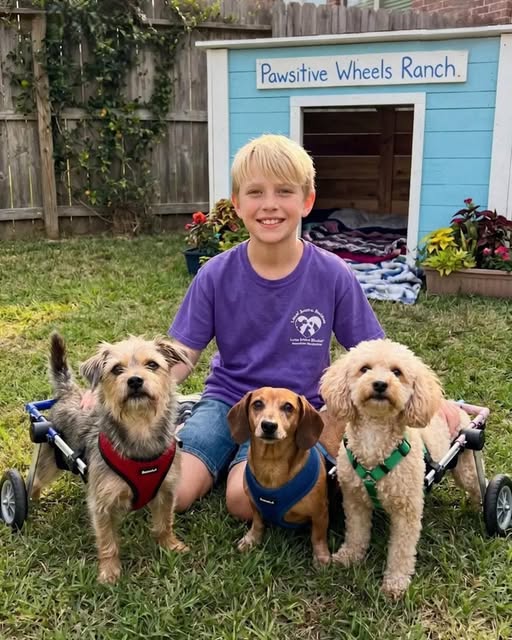
Ethan had never thought of himself as a hero. He never wanted attention, praise, or recognition. He simply couldn’t walk away from something that was broken and suffering. When he first found the three paralyzed dogs abandoned by the roadside, fragile and confused, he didn’t hesitate. He brought them home, built makeshift supports, learned how to craft wheelchairs for them with patient hands and sleepless nights. What began as an act of compassion slowly turned into a quiet mission—one that gave those dogs not just mobility, but dignity.
Their small shelter became a place of healing, of second chances. Until it wasn’t.
The night everything collapsed, Ethan stood in the wreckage of what he had built with his own hands. Broken wood scattered across the ground, torn fabric fluttering in the wind, the echoes of destruction hanging in the air like a heavy truth he couldn’t yet accept. For a moment, he believed he had failed them. That everything he had tried to protect had been erased in a single act of cruelty.
But grief has a way of revealing truths that comfort never could.
What he uncovered in the aftermath wasn’t just vandalism—it was intent. A deliberate act. A neighbor who had smiled politely in daylight but chosen destruction in the shadows, driven by resentment over something as trivial and hollow as a view.
When the footage finally surfaced, everything changed.
On a small, glowing phone screen, the truth played out without mercy. Every calculated movement. Every act of sabotage. Every second of cruelty captured clearly, leaving no room for denial, no space for excuses. Melinda’s confidence—once carried like armor—began to fracture in real time as the evidence spread beyond her control.
The power she once held in quiet intimidation dissolved under the weight of undeniable truth. And the same community she had once dismissed as insignificant no longer looked away.
They gathered instead.
Not with anger alone, but with certainty.
And in that shift, everything she had relied on—fear, silence, assumption—collapsed.
She was forced to watch as the world she tried to control rebuilt itself without her permission. The shelter rose again, stronger this time, shaped not only by Ethan’s hands but by the support of neighbors who refused to let kindness be erased. Children’s laughter returned, echoing through a yard she once dismissed as an eyesore, now alive with movement, warmth, and purpose.
From behind closed curtains, she watched it all unfold—the rebuilding, the healing, the quiet triumph of something she had tried and failed to destroy.
Ethan never set out to prove anything to anyone. But in protecting three helpless lives, he became something far greater than a caretaker. He became a reminder that compassion, even when tested, even when targeted, doesn’t break easily. And when pushed to its edge, it doesn’t fade—it strengthens, gathers others, and becomes a force that no single act of cruelty can undo.