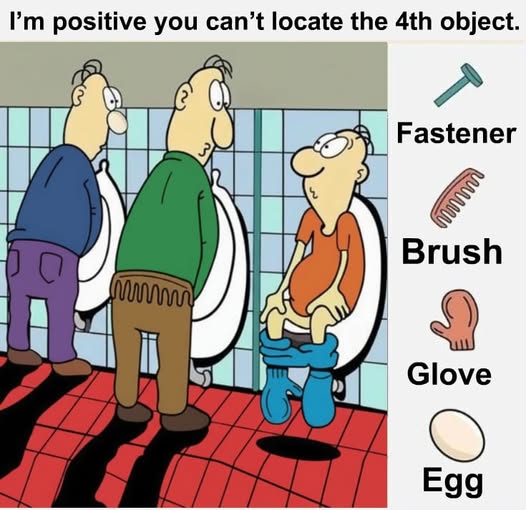
Public restrooms are one of those strange, overlooked spaces where human behavior becomes unexpectedly theatrical. They are not just functional rooms built for necessity—they are social pressure cookers disguised in tile and fluorescent lighting. In these places, dignity quietly negotiates with panic, and everyone seems to agree—without ever saying a word—that the less attention we draw to ourselves, the better.
There is an unspoken script we all follow when we step inside: keep your eyes forward, avoid unnecessary movement, pretend you are alone even when you are not, and most importantly, complete your business as efficiently and invisibly as possible. It is a carefully maintained illusion of order, built on mutual respect and collective discomfort. Everyone knows the rules, even if no one ever learned them formally.
That’s exactly why a moment of disruption—like a man calmly sitting at a urinal, pants down, completely unconcerned with convention—feels so jarring. It breaks the invisible agreement that holds the space together. Suddenly, the room becomes hyper-aware of itself. People freeze, glance, look away too quickly, or pretend they saw nothing at all. The silence becomes heavier, more deliberate. You can almost feel everyone mentally recalibrating what is “normal.”
And yet, even in that instant of collective shock, something interesting happens: the tension begins to bend toward humor. Because underneath the discomfort is a shared recognition that no one is truly in control of these awkward human moments. Everyone is just trying to get through them with as much composure as possible. The absurdity of the situation—so sharply out of place, so confidently breaking the rules—creates an almost irresistible urge to laugh.
That’s what makes the cartoon so effective. It captures not just an unusual scene, but the entire emotional spectrum that comes with it: confusion, discomfort, embarrassment, curiosity, and finally amusement. It freezes a moment where social expectations collide with pure human unpredictability.
Public restroom humor works for a reason. It’s not really about bathrooms—it’s about exposure. It reminds us that even in the most mundane settings, we are vulnerable, imperfect, and constantly navigating invisible social contracts. These spaces strip away polish and performance. No one is impressing anyone in a restroom; everyone is simply trying to exist with minimal awkwardness.
And when something disrupts that fragile balance, laughter becomes the release valve. It softens the embarrassment, diffuses the tension, and turns discomfort into something shared rather than endured alone. In that way, humor doesn’t just entertain—it reassures. It quietly says: everyone here is human, everyone here has awkward moments, and no one is as composed as they try to appear.
So what begins as a moment of shock slowly transforms into something more connective. The restroom, for all its awkward silence and rigid etiquette, becomes an unintentional stage where the reality of human behavior slips through. And in that brief, uncomfortable, and oddly funny pause, people are reminded of something simple but grounding—we are all improvising our way through the same unspoken rules.